Christmas Gifts for Grandparents: What Actually Gets Kept
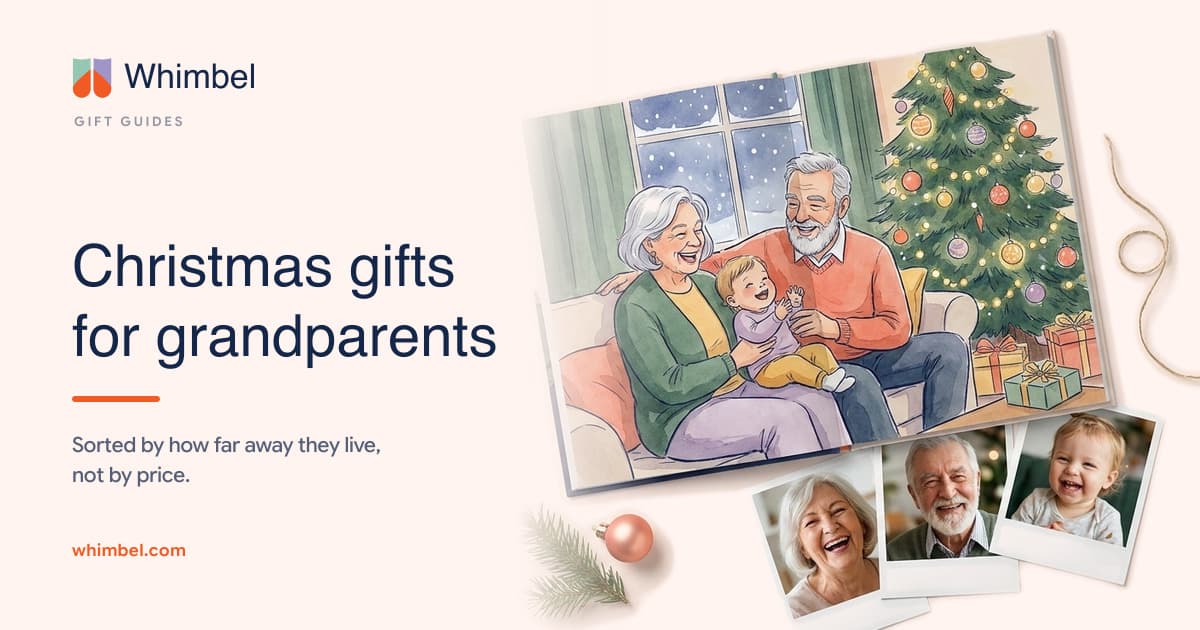
Christmas gifts for grandparents, organized by the one thing that actually changes the answer: how far away they live. Every figure taken from outside this site links to its source, our own dates and timings show their arithmetic, and anything we could not verify was left out rather than softened.
Key takeaways
- There are roughly 65 million grandparents in America, and 9 in 10 already give money to their grandchildren — an average of $2,654 each per year (AARP, survey of 3,283 grandparents, November-December 2025). The gift is flowing the other way all year. December is the one month it reverses.
- More than half of grandparents have at least one grandchild who lives more than 200 miles away, and about a third live more than 50 miles from the closest one (AARP, 2018). Distance is the most useful thing to know before you choose.
- Retailers expect 17% of holiday sales to come back as returns (NRF and Happy Returns, 2025). The goal is not a gift they like on the day. It is a gift still in the house in March.
- Gift cards are what people most want to receive — 50%, ahead of clothing at 46% and books and media at 27% (NRF, 8,247 consumers, October 2025). That is worth knowing, and it is still usually the wrong gift for a grandparent. We explain why below.
- The "give experiences, not things" advice is real but weaker for this recipient than the internet suggests. In a national telephone survey of 1,279 household financial decision-makers, 57% said an experience made them happier than a possession against 34% who said the reverse — but at ages 55 to 69 it was 49% against 38%, and among retired or unemployed respondents 47% against 39%. Experiences lead in every group the paper tabulates, as a plurality rather than a majority, and under half among the oldest, rural and retired respondents (Van Boven & Gilovich, Journal of Personality and Social Psychology, 85(6), 1193-1202, 2003).
Most gift guides for grandparents open by telling you that grandparents are hard to shop for because they already have everything. That is not quite the problem. The problem is that the money in this relationship runs almost entirely in one direction, all year, and then stops dead for one afternoon in December while everyone tries to run it backwards.
AARP's most recent grandparenting research, a survey of 3,283 grandparents fielded between 18 November and 22 December 2025, found that nine in ten U.S. grandparents provide financial support to their grandchildren, averaging $2,654 a year each. AARP counts about 65 million grandparents in America, with a mean of 4.9 grandchildren each. Collectively that is over $172 billion in direct support, plus an estimated $731 billion in unpaid care — more than $903 billion a year that moves from grandparents to the families below them. Both of those totals are AARP's own estimates rather than things the survey measured: the care figure values average caregiving hours at the $22.15 national hourly rate for childcare services, and the support figure is 65 million grandparents multiplied by that $2,654 average. Treat them as scale, not measurement.
So the honest framing for December is not "what do they need." They do not need. The framing is: what can you give back to somebody who has spent the year giving, that will survive contact with a house they are probably trying to keep less full.
That question has a different answer depending on one variable, and it is not budget. It is distance.
Start with how far away they live
AARP's 2018 grandparenting study — 2,654 grandparents aged 38 and over, surveyed 20 August to 4 September 2018 — found that more than half of grandparents have at least one grandchild living more than 200 miles away, and about a third live more than 50 miles from their nearest grandchild. The same study named distance as the single biggest barrier to seeing grandchildren, with the competing schedules of working grandparents and busy parents second.
That is the fork. A grandparent who sees your child every Sunday has a completely different unmet need from one who sees them twice a year. Guides that sort by price bracket get this backwards, because a $30 gift and a $300 gift can both be exactly right or exactly wrong depending on which side of that line the person is standing.
Three-quarters of grandparents (76%) told AARP that electronic technology helps them stay connected to their grandchildren. That is genuinely good news, and it also explains what the far-away grandparent is actually short of: not contact, but something to hold between calls.
Christmas gifts for grandparents who live far away
The organizing idea here is that a video call is a window and not a room. It ends and there is nothing left in the house. The best long-distance gifts leave an object behind, or they create a reason for the next call rather than being one.
A recorded read-aloud, in both directions. Ask them to record themselves reading three books on video — not one, three, because one gets worn out — and give your child the recordings for bedtime. Then send the reverse: your child reading to them. The practical detail that makes this work is that you have to do the recording for them, on your phone, during a visit. Asking a grandparent to produce and send video files is how this gift quietly never happens.
Two copies of the same book, one at each house. This is our favorite long-distance gift on the list and it costs the price of two books. They read the same pages at the same time over a call, both turning real paper. It works from about age two upward and it keeps working for years, because you can replace the title without replacing the ritual.
The visit itself, prepaid and dated. Not "come and see us sometime" — a booked ticket with a date on it. The reason to make this the gift rather than a standing offer is that the standing offer requires them to ask. AARP's 2018 study measured schedules as the second-biggest barrier after distance; that the ask itself is what usually fails rather than the willingness is our own read of it, not something the survey asked about.
A digital photo frame, with an honest warning. These are genuinely good for this exact situation: you push photos to it from your phone and it updates in their kitchen without them doing anything. The warning is that setup is not trivial and every one of these frames depends on their wifi. Give it only if you can set it up in person or talk them through it on the phone that day. A frame that stays in the box until March is worse than no gift.
Something that arrives at their house with your child's name on it. A subscription that lands monthly at their address — a magazine, a baking box, a seed kit — where the whole point is that it is meant to be done with the grandchild on the next visit. It converts a one-day gift into eleven more reminders.
A printed, captioned book of the year. The camera roll is not a gift, and neither is a shared album they will never open. The version that works is printed, has words under the pictures, and is short enough to actually get finished. This is the category our own product sits in, and we describe it honestly further down rather than pretending it is the only answer.
Christmas gifts for grandparents who see the grandchildren every week
The nearby grandparent has the opposite problem. They are not short of contact and they are not short of updates. They already have the drawings on the fridge. What they usually lack is anything that acknowledges how much of the week they are actually carrying.
AARP's 2026 research put a number on that load, and the number needs its base stated. About seven in ten grandparents (69%) provide some care for their grandchildren and 31% provide none (AARP Research, Key Findings, p.13). Across all grandparents, including that 31% at zero, the average is 510.9 hours a year — what AARP's study page calls the equivalent of 12.5 weeks of full-time work. That average is not the caregiver's own figure, and it is worth being careful with: AARP publishes no mean for caregivers alone, and among the 2,350 respondents who do provide care the median is 260 hours a year (annotated questionnaire, Q702). Separately, four in five (79%) say their grandparenting experience overall is extremely or very fulfilling (AARP, June 2026) — a question about grandparenting, not about the caregiving, and not a complaint. A median of 260 hours is still 260 hours.
Fix the thing in their house that your child broke or wore out. The step stool at their sink. The chair with the arm that went. The garden gate that does not shut since a toddler learned to swing on it. This is unglamorous and it is the gift most likely to be used every day. It requires you to have noticed, which is the actual content of the gift.
A year of the drawings, bound. Keep every drawing your child makes at their house, date them on the back through the year, and give the set back in December as a bound book or a boxed set rather than a folder. The material is free. The gift is that somebody kept it.
Tickets to the thing they already do, times two. Not a new hobby. The membership they already pay for, renewed, with a second card for the grandchild. Zoo, museum, botanical garden, the local pool. It makes the Wednesday afternoon they already spend together cheaper and slightly more special, which is a better outcome than introducing a new activity into a schedule that already carries a couple of hundred hours of grandchild care a year.
An actual date, written down. A voucher for a day out with just them and the grandchild, with the date already agreed and in your calendar. Undated vouchers expire in a drawer. This one is only a gift if you commit the day.
The good version of the thing they use daily for your child. The travel cot that is not from 1994. The car seat that does not require a twenty-minute argument. Deeply unromantic, immediately used.
Christmas gifts for grandma
This deserves its own section, not because grandmothers want categorically different objects, but because the conversation around the gift usually goes differently.
Start with "don't get me anything." It is worth taking seriously rather than treating as a formality. It usually means one of two specific things: I do not want more objects in this house, or I do not want you spending money on me. Those need different answers. The first is solved by a gift that is consumable, displayed in place of something else, or not physical at all. The second is solved by a gift whose value is obviously time rather than money — which is where the handwriting and the recordings below come in, and why they land harder than something expensive.
Her handwriting, made permanent. Take one recipe card in her own hand — the one that is stained and falling apart — and have it reproduced properly: printed on a tea towel, engraved on a cutting board, or simply scanned at high resolution, printed on decent paper and framed. Two practical notes. Photograph it flat, in daylight, without a flash, or the reproduction will look like a photocopy. And give the original back with it; the point is not to take the card away.
Her story, not only the grandchild's. The default gifts in this category are all about somebody else — a photo of the children, a frame for the grandchildren, a calendar of the grandchildren. A gift that is about her is uncommon enough to be startling. Interview her: where she grew up, how she met your father or your other parent, what her first job was, what she was afraid of at twenty. Record it on your phone. That recording, transcribed or made into a book, is the gift almost nobody thinks to give, and it has a deadline attached that the rest of this list does not.
Jewelry, only if it is specific. A generic necklace is a returned necklace. A necklace with a date on it that means something, or the grandchildren's names in her own preferred order, or a repair of the piece she already wears but has not worn since the clasp went — those work. The repair is the underrated one.
What to avoid for grandma specifically. Anything in the "World's Best Grandma" category, which is a gift about the sentiment of the giver rather than the taste of the recipient. Anything that needs a new shelf. Anything requiring her to create an account.
Christmas gifts for grandpa
The distance rule applies here in exactly the same way, so start there. Three additions come up often enough to be worth their own lines.
The tool or the good version he will not buy himself. The recurring pattern in this category is somebody using a worn-out version of something they reach for constantly and never replacing it, because replacing a working thing feels like waste. Doing it for him is not exciting and it is usually right.
Give him an archive job. The box of slides, the shoebox of prints, the camcorder tapes. Pay to have them digitized, then give him the files and ask him to tell you who everyone is. That is two gifts: the digitization, and being asked. The second is the one that matters, and it has the same deadline as the interview above.
A project with the grandchild that has an end. A model, a birdhouse, a seed tray, a jigsaw big enough to leave out. Something with a finish line so that it produces a Saturday rather than an obligation.
The first Christmas as grandparents
A genuinely different situation, because for once the recipient does want an object, and because the role itself is new.
The useful gifts here mark the transition rather than serving the baby. What they will not have and cannot buy for themselves is anything that says the word — grandma, oma, nonna, whatever your family has settled on, and the settling is itself part of it. Something with the name they have chosen, given by the parents, is the version of this that lands. Something with the baby's name on it is a gift to the baby that happens to be stored at their house.
Two practical notes for a first Christmas. Ask which name they have chosen before you engrave anything, because it is very common for the intended name not to be the one that survives. And if the baby arrived this year, the photograph they most want is the one of them holding the baby, printed, not the one of the baby alone.
The Christmases that are harder
Gift guides skip these, and they are a meaningful share of the actual situations people are shopping in.
The first Christmas after a grandparent has died. The surviving partner is the person to shop for and the rule is: acknowledge, do not surprise. A gift that reveals itself in front of the whole family as being about the person who died is a hard thing to be handed at a table. Give it privately, earlier, and say what it is before they open it. Memorial gifts that work tend to be ones that keep the person's voice or handwriting rather than their image — a recording, a recipe, a letter reproduced. If you are considering a memorial book or album, make it, then offer it rather than presenting it.
The year they are downsizing. If a grandparent has moved into a smaller place in the last eighteen months, or is about to, the correct number of new objects is close to zero. This is the clearest case in the whole guide for consumables, experiences, services and time — a cleaner for the winter, a meal delivery for January, the visit, the tickets. Adding to a house someone is actively trying to empty is a chore disguised as a present.
A grandparent living with dementia. The Alzheimer's Association publishes a holiday gift guide for exactly this, and it is better than anything we could improvise. It sorts its suggestions into three lists: the early stages, the middle-to-late stages, and a separate list of things that help with everyday tasks and keep the person engaged. The early-stage list includes a memory calendar featuring family photos. The everyday-tasks list, which is not scoped to a stage at all, includes a digital clock with large type to indicate date and time. For the middle-to-late stages it suggests music playlists of the person's favorite artists, comfortable loose-fitting clothing that is easy to put on and remove, framed photographs or a photo collage made specifically for them, and soothing objects such as a handheld massage ball. Read the guide before you buy; which of the three lists you are shopping from matters more than the category.
What to skip
Retailers expect 17% of holiday sales to be returned this season, according to NRF and Happy Returns, against a 15.8% return rate across the year as a whole and 19.3% for online sales specifically. All three of those are estimates the merchants made about their own business before the season started, not counts of returns that have already happened. Still: roughly one gift in six is expected to come straight back, and some categories are reliably in that sixth.
Gift cards, with a caveat. NRF's October 2025 survey of 8,247 consumers found gift cards are the most-wanted gift overall at 50%. That is a real finding and it is worth respecting for most recipients. It is still usually wrong here, for a structural reason: the person you are shopping for already gives your family an average of $2,654 a year. Handing money back to somebody who spends the year handing you money reads as a transaction rather than a gift, and it is very likely to end up spent on your own children anyway.
Anything with a slogan on it. Mugs, plaques, cushions and shirts in the "Best Grandma Ever" family are a gift about the sentiment of the giver rather than the taste of the recipient, and they compete for shelf space with things she chose herself.
Another photo frame. The frame is not the constraint. The printed photograph is. If you are inclined to buy a frame, print the photo instead and put it in a frame they already own.
Technology that requires a new account. Any device where the setup path includes creating a login, choosing a password and confirming an email is a gift with homework attached, unless you are physically present to do it.
Subscriptions that keep arriving. A three-month subscription is a gift. An auto-renewing one is a bill you have introduced into someone else's house. Buy the fixed-term version, or set the reminder to cancel it yourself.
When to order for Christmas delivery
Christmas Day 2026 falls on a Friday, which makes Thursday 24 December the last useful delivery day.
Anything printed and shipped needs to be ordered a good deal earlier than people expect. Our own timings are a worked example of why. We promise delivery at the latest 15 business days after the order to the US, Canada and the rest of the EU, and 10 business days to the UK, Germany, Austria, the Netherlands, Belgium, Luxembourg, Switzerland, Denmark, Sweden, Poland and Czechia, printing included. December adds a seasonal rush on top, so counting back from Thursday 24 December with three business days to spare, our order-by date for Christmas 2026 is Monday 30 November for the US, Canada and the EU, and Monday 7 December for the UK, Germany and their neighbours. That is not marketing urgency; it is the arithmetic. Most books arrive well before the promise, in about two weeks, and farther destinations need to order earlier.
Two things follow from that. If a gift has to be manufactured or personalized, late November is the real deadline, not mid-December. And if you miss it, a digital version that can be opened on the day and a physical copy that arrives in January is a legitimate answer rather than a failure — with our books the preview is ready in minutes, so the thing to unwrap on the day can exist even when the printed copy cannot. Our delivery timings page has the current dates.
Where a personalized book fits, and where it does not
We make illustrated hardcover books from a family's own memories, so treat this section as interested rather than neutral.
The case for it as a grandparent gift is specific. It is an object, which the long-distance grandparent is short of. It is about a real shared moment rather than a name dropped into a template, which is what makes it survive January. And it can be pointed in either direction: a book about the grandchild, given to the grandparent, or a book about the grandparent — their childhood, their work, the thing they are known for in the family — told from the grandchild's point of view. The second one is the version people tend not to think of, and it is the one that gets cried over.
Practically: a digital preview of the finished book is $7.99, the hardcover is $44.99 with the preview credited against it. Shipping is free to the US, Canada, the UK and most of Europe; elsewhere a delivery fee applies, shown before you pay, and the shipping page covers all 180 countries we ship to. You see the whole book before committing to print. There is more on the grandparent gift book page, and the personalized Christmas book page covers the December version, where the story is usually about the year the family just had rather than about Christmas itself. It is not only a children's product — the storybook for any age page covers books written for and about adults, which is what a tribute to a grandparent actually is.
The case against, stated plainly: it takes time you may not have, it needs a photograph of each person you want illustrated, and it is a poor choice if the grandparent is downsizing and genuinely wants no new objects. If you are in that last situation, go back up to the harder-Christmases section; the answer there is a service or a visit, not a book.
Frequently asked questions
What do you get grandparents who say they don't want anything?
Take it literally and separate the two things it usually means. If they do not want more objects, give something consumable, something that replaces an object they already have, or something that is not physical at all — a service, a repair, a booked visit. If they do not want you spending money, give something whose value is obviously your time: a recorded interview with them, their handwriting reproduced, a day out that you organize. Both readings are satisfied by a gift that could not have been bought quickly.
How much should you spend on a Christmas gift for grandparents?
There is no established figure specific to grandparents that we could verify. For context on the general envelope, NRF's October 2025 survey found consumers planned to spend $890.49 per person across the whole season, of which $627.93 was gifts for all family and friends combined. Split across a family, that puts most individual gifts well under $100, and nothing in this guide requires more than that.
What is the best Christmas gift for grandparents who live far away?
Something that leaves an object in the house or creates the next call. The two we would pick first are a set of recorded read-alouds in both directions, and two copies of the same book — one at each house — so a story can be read together over a video call with both of them turning real pages. More than half of grandparents have a grandchild over 200 miles away, so this is the majority case rather than the exception.
What is a good Christmas gift for a grandma who has everything?
Something about her rather than about the grandchildren. The default gifts in this category are all pictures of somebody else. Record an interview with her about her own life, or reproduce her handwriting from a recipe card or letter into something used daily. Both cost very little and neither can be bought by anyone else in the family.
When do I need to order a personalized book for Christmas delivery?
By Monday 30 November for Christmas 2026 for delivery to the US, Canada or the EU, and by Monday 7 December to the UK, Germany, Austria, the Netherlands, Belgium, Luxembourg, Switzerland, Denmark, Sweden, Poland or Czechia. We promise delivery there at the latest 15 and 10 business days after the order, printing included, and those dates leave three extra business days for the December rush. Farther destinations need to order earlier: the order-by dates list every country. If you miss that date, the digital preview is ready in minutes and can be given on the day with the hardcover following in January.
Should the gift come from the grandchildren or from the adults?
From the grandchildren, in almost every case, and this is the single easiest upgrade available. The same object handed over by a four-year-old who helped choose it is a different gift from the same object handed over by their parent. Where the child cannot meaningfully participate, having them add something small — a drawing inside the cover, a recorded message, their name written on the tag — is enough.
How this guide was made
Every figure taken from outside this site was read off one of the ten sources listed below, all of which were opened on 27 and 28 August 2026, and each figure links to its source rather than to a summary of the report. One source is an exception a reader should know about before clicking: the experiences-versus-possessions paper is a paywalled journal article, so its figures were read from the full text of the published article — the headline percentages on p. 1196, the subgroup table on p. 1197 — and the link is the article's permanent publisher record, which opens on the abstract rather than on the numbers. The numbers that are ours — the printing and shipping times, the order-by date — show their arithmetic instead, so you can check them.
Three claims were cut rather than softened, and naming them is part of the point. The Emory University "Do You Know" family-story scale, which gift writing about grandparents quotes constantly, was dropped because neither emory.edu nor the departmental blog that hosts it would open. AARP's grandmother-versus-grandfather breakdown was dropped because the PDF carrying it would not extract. And the familiar line that a dementia gift guide tells you to shop for the person as they are now rather than for their former tastes was dropped because the Alzheimer's Association page does not say it: the page describes its own lists as stage-specific, which is a different statement, and that is what this article now says instead.
Where a source says something more qualified than the popular version of it, the qualification is in the text, including where it cuts against the argument here. The experiences-versus-possessions finding is a plurality rather than a majority, and it is weakest among exactly the people this guide is about. AARP's headline hours figure is an average across all grandparents including the 31% who provide no care at all, which is a different claim from an average among the people who actually do the caring — and the only caregiver-based number AARP publishes is a median, not an average. The returns figures are merchants' pre-season estimates about their own sales, not measured returns.
The recommendations themselves are editorial judgment, not research findings, and they are informed by the fact that we sell one of the things on the list. Where that is a conflict, we have tried to say so in the same sentence rather than in a disclosure at the bottom.
Sources
- AARP, "Powering Families: The Essential Role of Grandparents in Care, Connection and Support," June 2026 — 3,283 U.S. grandparents aged 35+, fielded 18 November to 22 December 2025, mixed mode (online panel plus telephone), margin of error ±1.71%. The study page is the source of the $2,654 average annual spend, the nine-in-ten who give financial support, the ~65 million grandparents figure, the mean of 4.9 grandchildren, the $172 billion and $731 billion totals and the footnoted arithmetic behind them, the 12.5-weeks-of-full-time-work equivalent, and the 76% who say technology helps them stay connected. aarp.org study page
- AARP, the same study — Key Findings deck (PDF), page 13 — source of the 69% who provide some care, the 31% who provide none, and the 510.9-hour average. The slide labels that average in its own caption as the hours "all grandparents" spent "(including those with 0 hours)," on a base of all 3,283 respondents. The study page does not carry either figure; this deck does, which is why it is linked separately. Key Findings (PDF)
- AARP, the same study — annotated questionnaire (PDF) — source of the 260-hour median among the 2,350 respondents who provide care (Q702), and of the 79% who find grandparenting extremely or very fulfilling (Q202, "Overall, how fulfilling has your grandparenting experience been?", asked of all 3,283 respondents about grandparenting as a whole rather than about caregiving). AARP's own study page gives fulfilment as 80%; the questionnaire's reported top-two-box figure and the press release both say 79%, and 79% is what this article uses. Annotated questionnaire (PDF)
- AARP press release, "New AARP Research Reveals $900 Billion Grandparent Economy Powering American Families," 15 June 2026 — source of the four-in-five (79%) framing, and a second statement of the $172 billion and $731 billion totals. Its own one-line summary of the hours reads as though they belong to the grandparents who provide care; the Key Findings caption says the average is across all grandparents, and this article follows the deck. aarp.org
- AARP, "2018 AARP Grandparents Study" — 2,654 grandparents aged 38+, fielded 20 August to 4 September 2018. Source of the distance figures: more than half have at least one grandchild more than 200 miles away, about a third live more than 50 miles from the nearest, and distance is the biggest barrier to seeing them with schedules second. aarp.org
- National Retail Federation, "Consumers to Spend Second-Highest Amount on Record," 2025 holiday survey — 8,247 adult consumers, fielded 1-7 October 2025. Source of the $890.49 total, the $627.93 gift portion, and the most-wanted-gift percentages. nrf.com
- National Retail Federation and Happy Returns, "2025 Retail Returns Landscape," released 15 October 2025 — two surveys: 2,006 consumers who had returned at least one online purchase in the previous twelve months, and 358 ecommerce professionals at U.S. merchants with over $500 million in revenue. The 17% holiday figure, the 15.8% annual rate and the 19.3% online rate all come from the merchant survey, not from the consumer one. The press release describes the fieldwork as "this summer"; the report itself dates it August-September 2025, which is the window used here. press release, report page
- Alzheimer's Association, "Holiday Gift Guide for Caregivers and People Living with Dementia" — source of the stage-matched gift suggestions in the harder-Christmases section. Not a survey; it is the association's own published guidance, and it carries no publication date, so it is cited as accessed on 28 August 2026. alz.org
- Van Boven, L. & Gilovich, T., "To Do or to Have? That Is the Question," Journal of Personality and Social Psychology, 85(6), 1193-1202 (2003), doi:10.1037/0022-3514.85.6.1193 — the national survey in Study 2 is 1,279 Americans aged 21-69, reached by random-digit dialling and screened to people who identified themselves as the "primary financial decision makers in their households," fielded by Harris Interactive for Northwestern Mutual Financial Network in November-December 2000; 1,263 after exclusions. 57% (95% CI 54-60%) said their experiential purchase made them happier and 34% (95% CI 31-37%) said their material purchase did, with the remainder unsure. The paper states that women, younger individuals and urban or suburban respondents were more likely to favor experiences than men, elderly people and rural respondents were, and that experiences still came out ahead in every category it tabulates — as a plurality, not a majority: 49% against 38% at ages 55-69, 49% against 40% among rural respondents, 47% against 39% among the retired and unemployed. Outside that table the paper also reports that respondents with the lowest incomes were equally likely to name either kind of purchase, and that those with the least education leaned slightly towards possessions. Table 3 carries no confidence intervals and no significance tests, so the subgroup gaps are untested point estimates. Every figure above was read from the full text of the published article: the headline percentages and their confidence intervals on p. 1196, the subgroup rows of Table 3 on p. 1197. The link is the DOI, which is the article's permanent publisher record. Be warned that the publisher's copy is paywalled, so it opens on the abstract and a purchase page rather than on the numbers themselves. Van Boven & Gilovich, Journal of Personality and Social Psychology, 85(6), 1193-1202, doi:10.1037/0022-3514.85.6.1193
Every moment is a story waiting to be told.
Turn your family's real memories into a beautifully illustrated keepsake book.
Create your book