Mother's Day Gift Ideas: What to Give, by Who's Giving
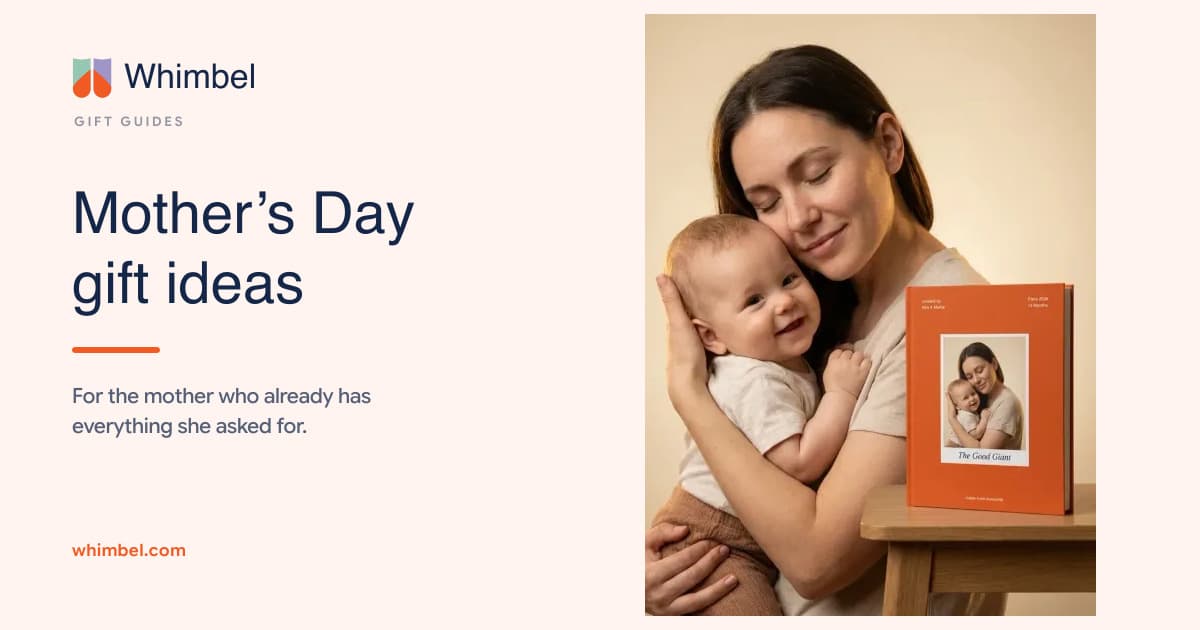
Mother's Day gift ideas sorted by who is actually giving — a small child, a grown-up child, or a partner buying on behalf of a baby who cannot. Those are three different problems and most lists answer only one. Every statistic in this guide comes from a page or paper we read, and links to its source.
Key takeaways
- The three buyers want different things. A seven-year-old needs something they can make. An adult daughter is usually buying for a relationship with history in it. A partner buying "from the baby" is really buying for a person who has not slept.
- 55% say they keep personalized gifts much longer than generic ones — an average of a full year longer, with nearly 40% saying they would keep one forever (OnePoll for Vistaprint, 2,000 Americans, posted 15 November 2019). A commissioned consumer survey, not research, and the page states no field dates.
- 57% of a national sample said an experiential purchase made them happier than a material one, against 34% for the reverse (Van Boven & Gilovich, 2003). Carry the qualification with it: in the paper's subgroup table the lead is a plurality rather than a majority in every row, and it falls under half among the oldest, rural and retired or unemployed respondents.
- US consumers said they planned to spend a record average of $284.25, with total Mother's Day spending forecast at a record $38 billion (NRF and Prosper Insights & Analytics, 7,877 U.S. adults surveyed 1-8 April 2026). Stated intentions collected before the day, not money counted after it.
- Retailers expect 17% of holiday sales to be returned (NRF and Happy Returns) — the pre-season estimate of 358 ecommerce professionals at large US merchants, not a count of returns that happened.
Nearly every Mother's Day list is organised by price or by product type. The more useful question is who is holding the money, because the answer changes everything about what lands.
When the gift is from a young child
The constraint here is not budget — it is that the gift has to be genuinely the child's, or it is a gift from you with their name on it.
The interview. Ask the child a fixed list of questions about their mother and write down the answers exactly as given, misunderstandings included. "How old is Mummy?" "Fifty." "What is she best at?" "Finding things." This is the highest-return twenty minutes available and it costs nothing. Date it, because the same questions next year are the actual gift.
A drawing, framed properly rather than stuck up. The difference between a drawing on the fridge and a drawing in a real frame is entirely the frame, and it converts a disposable thing into a kept thing.
Breakfast they actually made. Badly is fine. The point is authorship.
A coupon book, with the coupons written by the child. Not a printable. What a six-year-old chooses to offer — "one hug whenever you want", "I will not argue about shoes" — is funnier and more accurate than anything a template produces.
What to avoid: anything the adult clearly bought and the child clearly did not choose. Mothers can tell, and the gift becomes a small act of ventriloquism.
When the gift is from an adult child
Different problem entirely. She probably has what she needs, and the relationship has decades in it, which is both the opportunity and the reason generic gifts land so flatly.
Something about her, not about you. Almost every gift a mother receives is a reminder of her children. A gift that treats her as a person who existed before you did is rarer and lands harder.
Record her. Ask about her twenties — where she lived, what she earned, who she nearly married, what she was frightened of. Twenty minutes on a phone. This is the only item in this guide that gets harder to make every year, and the one people most often say they wish they had done sooner.
Her handwriting, made permanent. A recipe card in her hand, scanned properly and printed, or engraved. Photograph it flat, in daylight, no flash, or it reproduces like a photocopy.
The repair. The ring resized, the watch serviced, the photograph restored, the chair reupholstered. Almost nobody gives this and it returns something already loved to daily use.
Fix something in her house. Unromantic and immediately useful. It also requires you to have noticed, which is the actual content.
First Mother's Day, when the baby cannot buy anything
The most misunderstood case, because the gift is nominally from a baby and actually for someone in the hardest year of their life.
Sleep, arranged rather than offered. A morning where she does not get up, with the date agreed in advance and you doing the getting up. Open-ended offers do not count; they transfer the organising to her.
A photograph of her with the baby, printed. The person taking the photographs is never in them. This is the single most commonly missed gift of the first year.
Something for her rather than for the baby. The good robe, the coat that fits her now, a haircut booked with the childcare already covered.
Write down the year. Not the milestones — the ordinary parts. What she sang at 3am, the thing she said in the hospital, what she was like in the first week. She will not remember, and she will want to.
What to avoid: anything that generates work. A gift she has to assemble, learn, book or maintain is a task in wrapping paper.
What the research supports, and what it does not
Three numbers are worth having, all stated with their limits.
On experiences: across a national sample of 1,279 Americans, 57% said an experiential purchase made them happier than a material one, against 34% for the reverse. The two figures do not add up to a hundred because the rest said they were unsure. The frame matters as much as the numbers: it was a telephone survey of people who identified themselves as the primary financial decision-maker in their household, aged 21 to 69, fielded by Harris Interactive in November and December 2000, with 1,263 responses analysed after exclusions.
And the qualification, which cuts against the conclusion a gift guide would like to draw. The same paper reports that women, younger people and urban or suburban respondents favoured experiences more strongly than men, elderly and rural respondents did. That is a plurality in every row of its subgroup table, not a majority — 49% against 38% at ages 55 to 69, 49% against 40% in rural areas, 47% against 39% among retired or unemployed respondents — and that table carries no confidence intervals and no significance tests. Two groups outside it go further: the paper says respondents with the lowest incomes were equally likely to name a material purchase, and those with the least education were slightly more likely to. The survey's oldest band stops at 69, so it says nothing at all about mothers past that. If you are buying for a grandmother, weight the objects more heavily than a gift guide usually would — that is also the case our own grandparent gift book is built for, which we say plainly so you can see where our interest sits.
On personalization: a OnePoll survey of 2,000 Americans for Vistaprint, posted on 15 November 2019, found 55% say they keep personalized gifts much longer than generic ones, an average of a year longer, with nearly 40% saying they would keep one forever. That is a commissioned consumer survey rather than research, the page states no field dates, and it measures what people say rather than what they do. It is the best available number on the question and it should be read as modest support rather than proof.
On money: the National Retail Federation and Prosper Insights & Analytics put total US Mother's Day spending at a record $38 billion for 2026, with consumers planning a record average of $284.25 on gifts, up from $259.04 the year before. That comes from 7,877 U.S. adult consumers surveyed between 1 and 8 April 2026, with a margin of error of plus or minus 1.1 percentage points. Two limits to hold on to: it is a US survey, and it records what people said they intended to spend before the day rather than what they spent after it. Our own view is that it is a benchmark, not a target — several of the strongest ideas above cost nothing at all.
What we could not find: a well-known finding about requested versus surprise gifts. The paper does not open at any source we have tried, so it is not in this guide.
What to skip
Retailers expect 17% of holiday sales to be returned, against 15.8% across the year and 19.3% for online sales. The 15.8% and the 17% are retailers' own estimates, and the 17% is a forecast the merchant survey made before the season rather than a measurement of it.
Flowers as the whole gift. Fine alongside something. As the entire gesture they read as remembered-on-the-day, and they are also the most crowded choice there is: 75% of shoppers said they planned to buy flowers, more than any other category.
Anything that says "Best Mum" and nothing else. A slogan is a statement about the giver's feelings, not about her.
Kitchen equipment she did not ask for. The implication is rarely the intended one.
A spa voucher she has to book herself. Book it, with a date, and cover whatever she would otherwise be doing that day.
A repeat of last year. If the same thing has happened three years running it has stopped being a gift and become a routine, which is fine — but then it is not the gift, and something else needs to be.
Where a book fits, and where it does not
We make illustrated hardcover books from families' own memories, so read this as interested rather than neutral.
The case is narrow and specific: it works when the story is about her rather than about the children — her childhood, the year she moved countries, the thing she is known for in the family — told from a child's point of view. That is the version people do not think of, and it is the one that lands, because it inverts the usual direction of a Mother's Day gift.
The Mother's Day tribute page covers what it is and how it is made, and our pricing page has the numbers; this article deliberately is not a sales page for it. The storybook for any age page covers the same for other relationships, and the Father's Day guide is the companion to this one.
The case against, plainly: it takes time you may not have, it needs a photograph of each person illustrated, and it is the wrong choice for a first Mother's Day — in that year she needs sleep and a printed photograph of herself, not a project. If you are in that case, the section above is better advice than this one.
Frequently asked questions
What are good Mother's Day gift ideas from a young child?
Things the child genuinely authored. Interview them about their mother and write the answers down exactly as given, misunderstandings included — then date it and do the same questions next year. A drawing in a real frame rather than on the fridge. A coupon book where the child writes the coupons. What does not work is anything the adult obviously chose with the child's name attached.
What can you give a mother who says she wants nothing?
Something whose value is time rather than money, and something about her rather than about her children. Record her talking about her own early life — twenty minutes on a phone. Have her handwriting from a recipe or letter reproduced properly. Repair something she already wears or uses. All three cost little and none can be given by anyone else.
What is the best first Mother's Day gift?
Sleep, arranged rather than offered — a morning she does not get up, with the date agreed and you doing the getting up. Then a printed photograph of her holding the baby, because the person taking the pictures is never in them. Avoid anything she has to assemble, book or maintain.
Are experiences better Mother's Day gifts than objects?
On average yes, with a caveat. 57% of a national sample said an experiential purchase made them happier than a material one against 34% saying the reverse — but the same paper reports elderly and rural respondents favoured experiences less strongly than younger and urban ones did. That is a plurality in every row of its subgroup table rather than a majority, and it drops under half among the oldest, rural and retired or unemployed respondents. If you are buying for a grandmother rather than a new mother, weight the objects more.
How much should you spend on Mother's Day?
There is a published average to anchor against: consumers told NRF and Prosper Insights & Analytics they planned to spend a record average of $284.25 on gifts in 2026, from a US survey of 7,877 adults fielded 1-8 April. That is what people said they intended, not a bill you owe, and the strongest ideas in this guide — the recorded interview, the child's written answers, the printed photograph — cost almost nothing.
What is a good Mother's Day gift from a daughter specifically?
The one that treats her as a person rather than as your mother. Ask about her twenties and record it. Most of what she receives is a reminder of her children; almost none of it is interest in who she was before them.
How this guide was made
Every statistic here comes from a page or paper we opened, most recently on 28 August 2026, and each links to its source. The Van Boven and Gilovich figures previously linked to a university bibliographic record that carries none of them; they now link to the article's permanent publisher record, doi:10.1037/0022-3514.85.6.1193, and were read from the full text of the published article, which is paywalled there. One detail is not on a page we link: the fieldwork window for the returns research is printed in the report rather than in the press release, and the Sources entry below says so, and says why we do not link the file.
Three things in an earlier version were corrected against the sources rather than repeated. "A majority in every group" was wrong: the paper claims a greater proportion favouring experiences rather than a majority, and five rows of its subgroup table sit under 50%. The Vistaprint survey's "November 2019" was the date that page was posted, not the date the survey was fielded, and the page states no field dates at all. And this guide used to say that no reliable published figure for Mother's Day spend could be verified, which was simply false — the National Retail Federation and Prosper Insights & Analytics publish one each April, with the sample size and the field dates printed on the same page — so the figure is now in the guide and that sentence is gone.
One claim stays out rather than being softened: a well-known finding about requested versus surprise gifts, because the paper does not open at any source we have tried and we do not cite what we have not read.
The recommendations are editorial judgment, informed by the fact that we sell one of the things on the list.
Sources
- Vistaprint, "Study: US personalized holiday gifts more popular" — survey of 2,000 Americans conducted by OnePoll; posted 15 November 2019, and the page states no field dates. A commissioned consumer survey, not peer-reviewed research. Source in this article of the 55% who keep personalized gifts much longer, the average of a full year longer, and the nearly 40% who say they would keep one forever. vistaprint.com
- Van Boven, L. & Gilovich, T., "To Do or to Have? That Is the Question," Journal of Personality and Social Psychology, 85(6), 1193-1202 (2003) — Study 2 is a nationwide telephone survey of 1,279 Americans aged 21 to 69, all self-identified primary household financial decision-makers, fielded by Harris Interactive for Northwestern Mutual Financial Network in November and December 2000; 1% declined the key question and were excluded, giving an analysed N of 1,263. 57% (95% CI 54-60%) said their experiential purchase made them happier; 34% (95% CI 31-37%) said their material purchase did; the remainder were unsure. Source in this article of those figures and of the subgroup pattern: women, younger individuals and urban or suburban respondents favoured experiences more than men, elderly people and rural respondents did. Table 3 reports a greater proportion favouring experiences in every row, but that is a plurality and not a majority — ages 55-69 are 49% against 38%, rural 49% against 40%, retired or unemployed 47% against 39% — and the table carries no confidence intervals or significance tests. The headline figures are on p. 1196 and Table 3 on p. 1197, and both were read from the full text of the published article. The publisher's copy is paywalled: the link that follows is the permanent publisher record, which gives the abstract rather than the figures. Van Boven & Gilovich, J Pers Soc Psychol 85(6), 1193-1202, doi:10.1037/0022-3514.85.6.1193
- National Retail Federation and Prosper Insights & Analytics, "Mother's Day Spending Expected to Hit Record $38 Billion" — survey of 7,877 U.S. adult consumers conducted 1-8 April 2026, margin of error plus or minus 1.1 percentage points; released 21 April 2026. Source in this article of the record $38 billion total, the record average of $284.25 per person, the $259.04 average the year before, and the 75% of shoppers planning to buy flowers. All of it is stated purchase intent collected before the holiday, not measured spending. nrf.com
- National Retail Federation and Happy Returns, "2025 Retail Returns Landscape" / "Consumers Expected to Return Nearly $850 Billion in Merchandise in 2025" — two surveys: 2,006 consumers who had returned at least one online purchase in the past twelve months, and 358 professionals working in ecommerce at US merchants with over $500 million in revenue — 358 respondents, not 358 separate merchants. Released 15 October 2025. The press release calls the fieldwork "this summer"; the report's own methodology page gives the window as August-September 2025 (2025 Retail Returns Landscape, the page the report downloads from — we do not link the file itself, because its URL is a signed asset link re-signed on every request). Source in this article of 17% of holiday sales expected returned, 15.8% annual and 19.3% online. The release attributes the 15.8% and the 17% to retailers' own estimates and gives the 19.3% without saying whose estimate it is; the 17% is a forecast made by the merchant survey before the season rather than a measurement. nrf.com
Every moment is a story waiting to be told.
Turn your family's real memories into a beautifully illustrated keepsake book.
Create your book