Father's Day Gift Ideas From Kids, by What They Can Actually Do
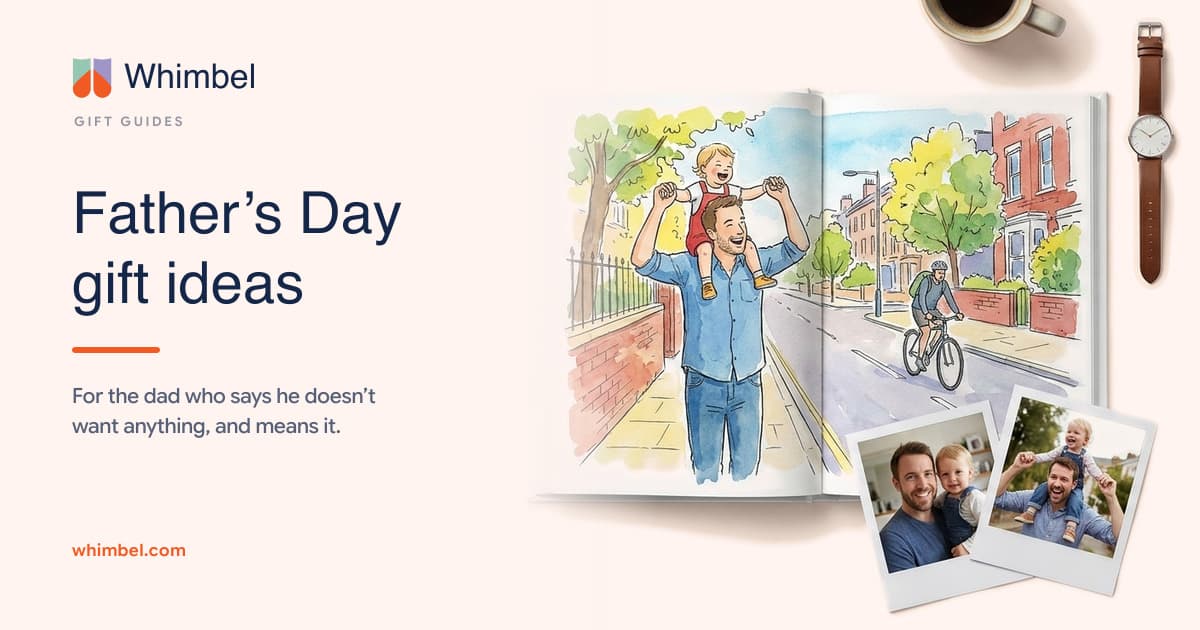
Father's Day gift ideas from kids, sorted by what a child of that age can actually do unaided — plus the first Father's Day, which is a different problem entirely. Every figure below names its source and links to it.
Key takeaways
- Sort by what the child can do alone, not by what looks good finished. A gift a four-year-old needed an adult to make is a gift from the adult. The whole value is authorship.
- For anything you buy rather than make, the AAP's line on toys applies to the dad-and-child gift too: it asks parents to "recognize that one of the most important purposes of play with toys, especially in infancy, is not educational but rather to facilitate warm, supportive interactions and relationships" (AAP). The best joint gift is one that needs two people.
- More than half (55%) said they keep personalized gifts much longer than generic, store-bought ones, and separately the average respondent said a full year longer (OnePoll for Vistaprint, posted November 2019). A commissioned consumer survey, not research.
- 57% said an experience made them happier than a possession, against 34% and the rest unsure — a plurality in every group the paper tabulates, but under half among the oldest, rural and retired respondents (Van Boven & Gilovich, 2003, pp. 1196–1197).
- Retailers expect 17% of holiday sales to be returned — their own estimate, not a measurement (NRF and Happy Returns).
Search results for Father's Day are dominated by lists of things to buy a man. That is a different question from what most people are actually solving on the day, which is: what can my child give their dad that is genuinely from them?
The buying question is a big one. The National Retail Federation and Prosper Insights & Analytics expect 2026 Father's Day spending to reach a record $27.9 billion, an average of $226.58 per person, up from a previous record of $199.38 in 2025 — a forecast from a survey of intentions, not a measurement of what gets spent. That expected average is the market this guide is not about. A handprint costs nothing and outlasts most of what $226.58 buys.
So this guide is organised by what a child can do without an adult finishing it for them.
Father's Day gift ideas from kids, by what they can manage alone
Ages 2–4 — hands and voice. A handprint on plain paper, in one colour, unframed at the time and framed by you afterwards. Or a recording: ask four questions about Dad and let the answers stand exactly as given. "What does Daddy do at work?" "Sits." That is the gift; do not correct it.
Ages 5–7 — the questionnaire. A fixed list, same every year, written in their handwriting. How old is Dad, how tall, what is he best at, what does he always say, what is his job. Date it. The first one is charming; the fifth one is an heirloom, and the only way to have five is to start.
Ages 8–11 — something with a use. This is the age where children want the gift to work. A bookmark they made, a playlist they chose, a meal they can genuinely cook with supervision, a washed car. The competence is the point.
Ages 12+ — the thing they noticed. Teenagers give badly when told what to give and well when left to notice something. The gift that lands is usually evidence of attention: the specific hot sauce, the band, the tool he mentioned once.
All ages — the coupon book, if the child writes the coupons. Not a printable. What a child chooses to offer is the interesting part.
First Father's Day
Different problem. The baby cannot give anything, so this is really a gift for a man in the hardest year of his life, bought by a partner or by his own parents.
A printed photograph of him holding the baby. Not the baby alone. First-year photographs are overwhelmingly of the child; the parent is behind the camera. This is the most commonly missed gift of the year and among the cheapest.
Time that is genuinely his. A morning out, arranged, with the childcare covered and the date agreed. Unbooked offers transfer the organising back to him.
Something that fits the man he is now. Clothes that fit his current life rather than his previous one; the bag that carries baby things without announcing it.
Write down the first weeks. Not milestones — what he was like. What he said in the hospital, what he was frightened of, what he did at 3am. He will not remember and he will want to.
What to avoid: a gift that generates work. Anything to assemble, learn, book or maintain is a task with a bow on it.
Personalized Father's Day gifts, and what the evidence actually supports
The support for personalization is real but modest, and worth stating accurately. A OnePoll survey of 2,000 Americans commissioned by Vistaprint found more than half (55%) said they keep personalized gifts much longer than generic, store-bought ones. Separately, and this is a different measure, the average respondent said they keep them for a full year longer, and nearly 40% said they would keep one forever. That is a commissioned consumer survey rather than research, it was posted in November 2019 with no field dates given, and it measures what people report rather than what they demonstrably do.
What that suggests in practice: personalization works when it is specific, not when it is a name. An engraved first name on a mass-produced item is personalization in the weakest sense. A date that means something, an inside joke, a phrase only this family uses, or a child's own handwriting reproduced is personalization in the real one.
On experiences over objects, the same finding as elsewhere applies. In a telephone survey of 1,279 Americans aged 21–69, all of them self-identified household financial decision-makers, 57% said their experiential purchase had made them happier against 34% who said their material one had, with the remainder unsure. The caveat matters more on this page than on most. The paper reports a plurality favouring experiences in every demographic category it tabulates, and under half among the oldest, rural and retired respondents: 49% against 38% among respondents aged 55 to 69, 49% against 40% among rural respondents, and 47% against 39% among the retired and unemployed. It also notes that respondents with the least education were slightly more likely to say a material purchase had made them happier. So for a grandfather, weight the objects more than a gift guide usually would — this is the case where something made to keep, like a book about a grandparent, holds up better than a day out.
Gifts that are actually for both of them
The strongest category, and the one the AAP's toy guidance points at directly. Its news page on the clinical report asks parents and caregivers to "recognize that one of the most important purposes of play with toys, especially in infancy, is not educational but rather to facilitate warm, supportive interactions and relationships" — a recommendation to parents rather than a stated finding, and about toys specifically rather than play in general. Its toy-buying page gives the practical version: "The best toys are those that match your child's developmental skills and abilities and encourage the development of new skills." And on the news page again: "Electronic toys by themselves do not provide children with the interaction and parental engagement that is critical to healthy development, according to the report."
Read as a Father's Day instruction: buy the thing that requires two people.
A project with an end. A model, a birdhouse, a seed tray, a jigsaw big enough to leave out. A finish line turns it into a Saturday rather than an obligation.
Tickets to the thing he already likes, times two. Not a new hobby introduced by gift. The one he has, with the child attached.
A standing appointment. The same thing, same time, every month, starting on a date. Small and repeated beats large and singular.
What to skip
Retailers expect 17% of holiday sales to be returned, against 15.8% across the year and 19.3% for online sales. All three are retailers' own forward estimates rather than counted returns, which is reason enough to buy fewer things more carefully.
Novelty items with "Dad" on them. Mugs, socks, plaques. They are statements about the occasion rather than about him.
Gadgets he did not mention. The failure rate is high and the return rate higher.
Anything requiring a new account. A device whose setup involves creating a login and confirming an email is homework, unless you are doing the setup.
A child-made gift the adult clearly made. The most common miss in this whole category. Imperfect and genuinely theirs beats neat and ventriloquised, every time.
Grooming sets nobody asked for. The implication is rarely the intended one.
Where a book fits, and where it does not
We make illustrated hardcover books from families' own memories, so read this as interested rather than neutral.
The case here is specific: it works when the story is about him — his childhood, his work, the thing he is known for in the family — told from the child's point of view. That direction is unusual, because almost everything a father receives on the day is about his role rather than about him, and it is why this version tends to land.
The Father's Day tribute page covers what it costs and how it is made; this article is deliberately not a sales page for it. The storybook for any age page covers the same for other relationships, and the Mother's Day guide is the companion to this one.
The case against, plainly: it takes time, it needs a photograph of each person illustrated, and it is the wrong gift for a first Father's Day — that year the answer is a printed photograph of him holding the baby and a morning off, both of which are in the section above and both of which are better advice than this.
Frequently asked questions
What are good Father's Day gift ideas from kids?
Sort by what the child can do without an adult finishing it. Two to four: a handprint, or four recorded answers about Dad left exactly as given. Five to seven: a written questionnaire, the same questions every year, dated. Eight to eleven: something with a use — a meal they cook, a car they wash, a playlist they chose. Twelve and up: the thing they noticed he wanted. A gift the adult obviously made is a gift from the adult.
What is the best first Father's Day gift?
A printed photograph of him holding the baby — first-year photographs are almost all of the child, because the parent is behind the camera. Then time that is genuinely his, with the date agreed and childcare covered. Avoid anything he has to assemble, book or maintain.
Do personalized Father's Day gifts actually work better?
Modestly, on the best evidence available. A OnePoll survey for Vistaprint found more than half (55%) said they keep personalized gifts much longer than generic, store-bought ones; separately, the average respondent said a full year longer, and nearly 40% said they would keep one forever. It is a commissioned consumer survey rather than research. In practice it works when it is specific: a meaningful date, an inside phrase or a child's handwriting, rather than a first name engraved on something mass-produced.
What can you give a dad who says he doesn't want anything?
Something whose value is time, or something that fixes an annoyance he has stopped mentioning. A standing monthly appointment with the child, starting on a set date. A repair of something he uses daily. Or the archive job — pay to have his old photographs or tapes digitised, then ask him to tell you who everyone is.
What should a child give a dad who is hard to buy for?
Attention, made visible. The questionnaire works at every age because the answers are unrepeatable and improve as the child grows. For older children, the gift that lands is evidence they noticed something he said once.
Are experiences better Father's Day gifts than objects?
On average yes — 57% of a national sample said an experiential purchase made them happier than a material one, against 34% for the reverse. But the paper reports a plurality rather than a majority in several groups: 49% against 38% among respondents aged 55 to 69, and 49% against 40% among rural respondents. So for a grandfather, weight the objects more heavily than a gift guide usually would.
How this guide was made
Every figure here comes from a page we opened on 28 August 2026, and each one links to its source. The experiences-versus-possessions paper is the one exception a reader should know about: it is a paywalled journal article, so the figures were read from the full text of the published article and the links go to the publisher’s permanent record, doi:10.1037/0022-3514.85.6.1193, with the page number for every figure given in Sources.
Two corrections are worth naming. The paper reports a plurality favouring experiences in every demographic category it tabulates, and under half among the oldest, rural and retired respondents; an earlier version of this guide called that a majority in every group, which it is not. And an earlier version said there was no traceable figure for average Father's Day spend. There is one, on the NRF and Prosper Insights & Analytics release, and it is now in the opening section with its survey size and field dates in Sources.
One claim is still left out. A well-known finding about requested versus surprise gifts is not cited here, because the paper could not be opened at any source we tried — we do not cite what we have not read, even when the result is widely reported.
Two qualifications are carried through rather than tidied away, because both cut against the easy version of the advice. The experiences finding comes from a survey of household financial decision-makers answering at the end of a long financial-planning questionnaire, not from a general population sample. And the AAP's warm-interactions line is a recommendation to parents about play with toys, especially in infancy — not a measured result about play in general.
This guide also deliberately does not target the broadest Father's Day search terms. Those results are national magazines and large retailers, and an article of ours would not be useful there. This one is written for the narrower question people actually bring: what can a child give.
Sources
- American Academy of Pediatrics, "Ignore the Flashing Screens: The Best Toys go Back to the Basics" — consumer news explainer for the clinical report Selecting Appropriate Toys for Young Children in the Digital Era, Pediatrics, posted 3 December 2018. Source of the warm-interactions recommendation and the electronic-toys line, both quoted with their own hedges intact. healthychildren.org
- American Academy of Pediatrics, "Toy Buying Tips for Babies & Young Children: AAP Report Explained" — the parent-facing guidance page for the same clinical report, filed under Ages & Stages / Baby. Source of the developmental-match line, which is on this page and not on the news page above. healthychildren.org
- Vistaprint, "Study: US personalized holiday gifts more popular" — survey of 2,000 Americans conducted by OnePoll; posted 15 November 2019, field dates not stated on the page. A commissioned consumer survey, not peer-reviewed research. vistaprint.com
- Van Boven, L. & Gilovich, T., "To Do or to Have? That Is the Question," Journal of Personality and Social Psychology, 85(6), 1193–1202 (2003) — Study 2 is a Harris Interactive random-digit-dial telephone survey of 1,279 Americans aged 21–69, all self-identified household financial decision-makers, fielded November–December 2000 for Northwestern Mutual Financial Network; 1,263 after exclusions. 57% versus 34% with 95% confidence intervals of 54–60% and 31–37% on p. 1196; the demographic table, where the oldest, rural and retired groups fall under 50%, is on p. 1197. Both were read from the full text of the published article; the publisher’s copy is paywalled. Van Boven & Gilovich, J Pers Soc Psychol 85(6), 1193–1202, doi:10.1037/0022-3514.85.6.1193.
- National Retail Federation and Prosper Insights & Analytics, "Father's Day Spending to Hit Record $27.9 Billion" — survey of 7,914 consumers, conducted 30 April – 6 May 2026, margin of error plus or minus 1.1 percentage points; released 10 June 2026. Source of the $27.9 billion total and the $226.58 average. nrf.com
- National Retail Federation and Happy Returns, "Consumers Expected to Return Nearly $850 Billion in Merchandise in 2025" — two surveys, 2,006 consumers who had returned at least one online purchase in the past year and 358 ecommerce professionals at US merchants with more than $500 million in revenue; released 15 October 2025. The press release says the two surveys were conducted "this summer"; the report's own methodology page gives the window as August–September 2025 (2025 Retail Returns Landscape, the page the report downloads from — we do not link the file itself, because its URL is a signed asset link that is re-signed on every render). Source of 17% of holiday sales expected returned, 15.8% annual and 19.3% online; the 17% is the merchant survey's forward estimate, not a consumer-reported figure. nrf.com
Every moment is a story waiting to be told.
Turn your family's real memories into a beautifully illustrated keepsake book.
Create your book