Meaningful Baby Shower Gifts (And Four Worth Skipping)
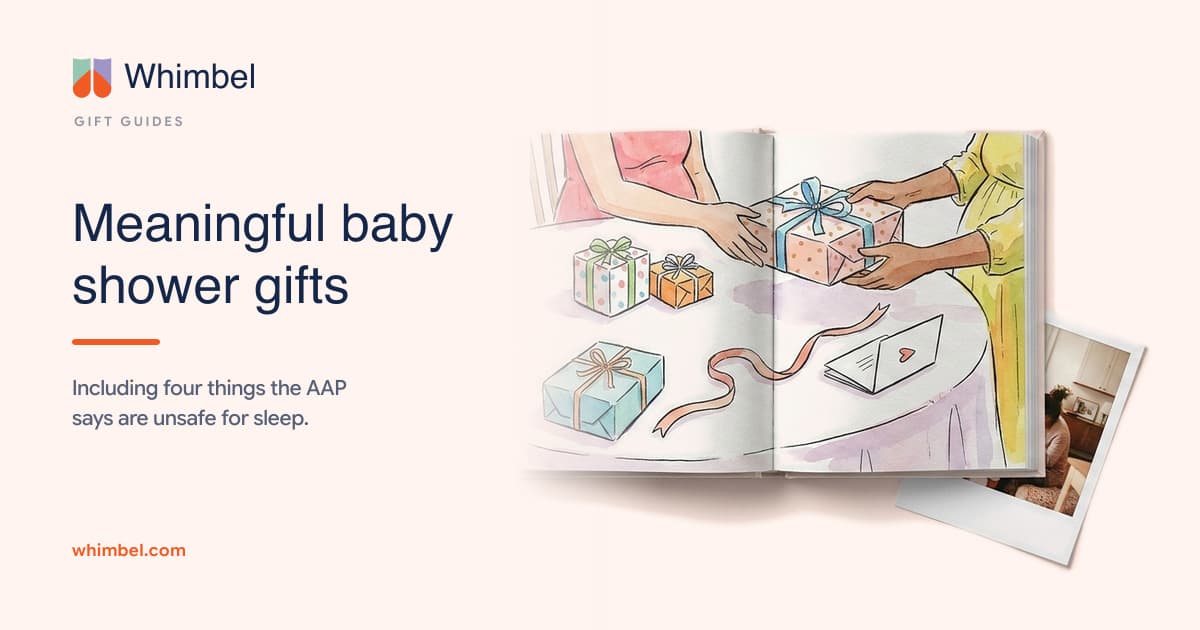
Meaningful baby shower gifts, including four things the American Academy of Pediatrics calls unsafe in a baby's sleep space. Every figure below that comes from outside this site links to the page it came from, and where no reliable number exists this guide says so instead of inventing one.
Key takeaways
- Four popular shower gifts are unsafe in a baby's sleep space: weighted blankets, sleepers and swaddles; crib bumpers and anything that attaches to crib slats; any sleep surface inclined more than 10 degrees; and loose bedding, pillows and pillow-like toys (AAP, 2022 policy explained). The AAP names each product as unsafe to use; grouping them into a shortlist of four gifts is ours. This is the most useful thing in this guide.
- 55% of people say they keep personalized gifts much longer than generic ones — on average a full year longer — and nearly 40% say they would keep one forever (OnePoll survey of 2,000 Americans for Vistaprint, posted 15 November 2019; the page states no field dates).
- On toys, the AAP's own wording is more careful than the version gift guides usually quote: "the best toys are those that match your child's developmental skills and abilities" (AAP toy-buying tips), and "electronic toys by themselves do not provide children with the interaction and parental engagement that is critical to healthy development, according to the report" (AAP news release on that report).
- Retailers expect 17% of holiday sales to be returned (NRF and Happy Returns). A shower concentrates the same effect into one afternoon.
- There is no reliable published figure for average baby shower gift spend, and this guide does not give one. See the note at the end about why that matters here in particular.
Most unique baby shower gift ideas lists are organised by price. That is the wrong axis, because the thing that decides whether a shower gift is good is not what it cost — it is whether the parents already have four of them, and whether it is safe to use at all.
So this guide starts with the second question, which almost no gift guide asks.
Four baby shower gifts to skip, and what the AAP says about each
These are all popular, all widely sold, and each one is named in the American Academy of Pediatrics' explainer of its revised 2022 safe-sleep policy. Two things about that page are worth stating plainly, because gift guides tend to blur them: the AAP is writing to the parent who will use the product, not to the person buying it, and it does not group these as a set of four. The shortlist is ours; the safety wording is theirs. If you buy one, the parents have to decide between using something unsafe and telling you they threw your present away.
Weighted sleep products. The AAP guidance is unambiguous: "Don't use weighted blankets, sleepers, swaddles or other weighted objects on or near your baby." These are marketed heavily on the promise of longer sleep, which is exactly what an exhausted new parent is looking for.
Crib bumpers and anything that attaches to the slats. The same page groups these with the things that must stay out of the sleep space entirely — "pillows and pillow-like toys, quilts, comforters, mattress toppers, non-fitted sheets, blankets, toys, bumper pads or related products that attach to crib slats or sides" — because "these objects can increase your baby's risk of entrapment, suffocation or strangulation."
Inclined sleepers. The AAP's line on angle is specific and worth remembering: "Any surface that inclines more than 10 degrees isn't safe for your baby to sleep on." The same angle is written into US law. The Safe Sleep for Babies Act, passed by Congress in 2022, bans "Inclined sleepers that lift an infant's head more than 10 degrees" — and the AAP notes that, sold as baby pods, wedges or nests, "these products are still linked with dozens of infant deaths every year and continue to pose serious risks." Congress banned them; the AAP recommends against them. Both are worth knowing before you buy one secondhand.
Decorative bedding sets. We have no figure for how often the quilt-and-bumper set gets given and we are not going to invent one, but our own impression is that it is a shower staple — and almost none of it can go in the crib. If you love the pattern, buy the fitted sheet from the set and nothing else.
None of this is a reason to be nervous about giving a gift. It is a reason to give one of the many things below instead, all of which are used outside the crib.
Meaningful baby shower gifts that get used
Something in the size nobody buys. Everyone gives newborn and 0-3 months. Buy 9-12 months, or 12-18. It arrives exactly when the drawer is empty and the parents have no time to shop, and it is the single most reliably welcomed gift on this list.
A meal, delivered later. Not at the shower. Arrange one for six weeks after the birth, when the casseroles have stopped and nothing else has. Put the date in your own calendar, because this only works if you remember it and they do not have to ask.
The unglamorous consumables, in bulk. Nappies past newborn size, wipes, laundry detergent for sensitive skin, nipple cream, muslins. Nobody photographs these being unwrapped and every one of them gets used.
An hour of somebody else's competence. A lactation consultant session, a postnatal doula visit, a cleaner. If several guests are willing to pool, this is where the pooled money should go — it is the category that individual guests can rarely afford alone and that parents almost never buy for themselves.
Board books, several. The AAP's framing of what matters at this age is worth quoting in full, because it is written as advice to parents rather than as a research finding. Under the standing line "The AAP recommends that parents and caregivers:", its news release on its toy report asks them to "recognize that one of the most important purposes of play with toys, especially in infancy, is not educational but rather to facilitate warm, supportive interactions and relationships." Note what that is not: not the primary purpose of play, and not play in general — one of the most important purposes of play with toys, especially in infancy. A book is that, in object form, and it survives being chewed.
Something for the person giving birth. Almost every gift at a baby shower is for the baby. A good robe, a proper water bottle, a gift card for a meal out in four months' time — anything that treats the parent as a person who also exists.
Unique baby shower gifts, when you want something remembered
Most unique baby shower gift ideas are unique in the sense of being unusual. The ones worth giving are unique in the sense of being un-duplicable — nobody else at the shower could have brought them. The evidence on personalized gifts is more modest than gift guides usually claim, and it is worth stating accurately. In a OnePoll survey of 2,000 Americans commissioned by Vistaprint, posted in November 2019 with no field dates given on the page, 55% said they keep personalized gifts much longer than generic, store-bought ones — on average a full year longer — and nearly 40% said they would keep one forever.
That is a commissioned consumer survey, not a study; it asked about holiday gifts rather than shower gifts; and it says people report keeping things longer rather than that they demonstrably do. It is still the most solid number available on the question, and it points the same way common sense does.
A letter to the child, sealed until eighteen. Costs an envelope, and it is the only gift here that gets harder to make later.
A book with the date in it. Not personalized in the name-swapped sense — a good picture book with a handwritten inscription and the date. In fifteen years the inscription is the part that matters.
A recording of you reading something. Especially if you live far away. It gets played more than you would think, and it costs nothing but the twenty minutes.
A specific, useful thing they mentioned once. The highest-scoring gift at any shower is the one that proves somebody was listening. It does not need to be personalized to be personal.
Where a keepsake fits, and where it does not
We make illustrated hardcover books from a family's own memories, so read this section as interested rather than neutral.
The honest case at a baby shower is narrower than at any other occasion on this site, and it has a timing problem: before the birth there is no story yet. A keepsake made from real moments needs real moments, and at a shower nothing has happened.
So the version that works here is a voucher rather than a finished book — something the parents redeem later, when there is a first year to make a book out of. The version that does not work is a book made now about a baby nobody has met, which is a template with a name in it, and that is the thing this whole site exists to be an alternative to.
Practically: a digital preview of the finished book is $7.99, the hardcover is $44.99 with the preview credited against it — the pricing page has the full breakdown. Shipping is free to the US, Canada, the UK and most of Europe; elsewhere a delivery fee applies, shown before you pay, and the shipping page covers all 180 countries we ship to. The baby shower keepsake book page covers this properly, and the new baby book is the one most families actually make once the baby arrives. If the shower is for a second child, the first birthday guide covers the same question a year on.
The case against, plainly: if the parents have asked for practical things, give practical things. The list above starts with clothes in the size nobody buys, and that advice is better than ours.
What to skip
Retailers expect 17% of holiday sales to be returned, against 15.8% across the year and 19.3% for online sales — the first two are retailers' own estimates, and all three are projections for a year that had not finished when the survey ran rather than measurements taken after it. A shower produces the same pile in one afternoon, in a house that has not made room yet.
Newborn-size clothing. They will be given more than the baby can wear before outgrowing it, and some babies skip the size entirely.
Anything with a battery that performs on its own. The AAP's news release on its toy report puts it this way, with its own hedges left in: "Electronic toys by themselves do not provide children with the interaction and parental engagement that is critical to healthy development, according to the report."
Large equipment nobody asked about. Swings, bouncers, walkers, activity centres. The parents have thought about their floor space and the registry exists for exactly this. Buy from it.
Anything off-registry that duplicates something on it. A registry is a list of what they decided they need. Going off it is only a good idea for the categories above — consumables, services, food, later-dated things — not for a different brand of the item they already chose.
Keepsake boxes for hospital bracelets and locks of hair. Common and well-meant, and — our opinion rather than a measured fact — usually still empty a few years later. If you want the sentimental slot, the letter is better.
Frequently asked questions
What are the most meaningful baby shower gifts?
The ones that arrive when the attention has stopped. Clothes in a size nobody else buys, a meal arranged for six weeks after the birth rather than the day of it, or an hour of professional help like a lactation consultant. All three are used at the point when the shower is long over and nobody is bringing anything round any more.
What should you not give at a baby shower?
Four things, each named as unsafe for a baby's sleep space in the AAP's 2022 safe-sleep guidance: weighted blankets, sleepers or swaddles; crib bumpers and anything attaching to crib slats; any sleep surface inclined more than 10 degrees; and loose bedding, pillows or pillow-like toys. Decorative bedding sets usually contain at least one of these. The AAP writes that guidance for the parent using the product rather than for the giver, and the shortlist of four is ours rather than theirs. Beyond safety, skip newborn-size clothing and large equipment that was not on the registry.
How much should you spend on a baby shower gift?
We could not verify any reliable published figure and we are not going to invent one. An earlier version of this article cited an average that did not exist in the source it named. What is worth saying instead: the two most valued gifts on this list — a letter to the child and a meal arranged for six weeks after the birth — cost almost nothing, and the most expensive category, professional help, is the one guests are meant to pool for.
Are personalized baby shower gifts actually worth it?
Modestly, on the best evidence available. A OnePoll survey of 2,000 Americans for Vistaprint, posted in November 2019, found 55% say they keep personalized gifts much longer than generic ones, an average of a year longer, with nearly 40% saying they would keep one forever. That is a commissioned consumer survey rather than a study, it asked about holiday gifts, it measures what people say rather than what they do, and the page gives no field dates — but nothing better exists on the question, and it agrees with the obvious.
Should you buy off the registry?
Buy from it for anything the parents chose deliberately — equipment, brands, sizes. Go off it only for the categories a registry cannot hold: consumables in bulk, food after the birth, services, and anything dated for later. Buying a different brand of something already on the registry is the one clearly wrong move.
What is a good baby shower gift from a group?
Something no individual guest can afford alone and no parent buys for themselves. A block of lactation consultant or postnatal doula sessions, a cleaner for the first month, or a meal delivery service for six weeks. Pooling turns a pile of small duplicated objects into one thing that changes a week.
How this guide was made
Every figure and quotation here that comes from outside this site was read on a page we opened on 28 August 2026, and each one links to the page that carries those exact words. That last part is itself a correction. An earlier version pointed two AAP quotations — the electronic-toys sentence and the warm-interactions sentence — at healthychildren.org's toy-buying page, which contains neither. Both live on the AAP's news release about the same clinical report, and both now link there. The warm-interactions quotation was also cut short: it ends "warm, supportive interactions and relationships", and the last two words are back.
The first section used to be headed as though the AAP had named four presents nobody should hand over. It says no such thing. Its safe-sleep pages tell the parent using a product not to use it, say nothing anywhere about giving, and never group these products into a set of four. The heading now says what is true: the shortlist is ours, the safety wording is the AAP's. The article's own headline and its meta title carried the same overreach, and both have been changed with it.
This article replaces an earlier version in which our own statistics audit of 28 August 2026 could verify none of nineteen factual claims — the worst score on the entire blog. That is our own count rather than a published figure, which is why it is the one number here without a link. It asserted that 65% of baby shower gifts go unused within six months, citing a What to Expect survey that does not appear to exist; that the average gift spend is $30–50, citing The Knot; and that personalized gifts are three times more likely to be kept, which the real underlying survey does not say.
That last one is instructive, because there was a real source underneath it. The Vistaprint/OnePoll survey says 55% report keeping personalized gifts about a year longer. Somebody turned that into "three times more likely to be kept". The number here is the one the survey actually reports, with its limitations stated.
Four more claims came out of this version. Dropped outright: a sentence asserting that most loungers and rockers sold for napping exceed the ten-degree limit. No AAP page states any proportion; joining the 10-degree limit to the existence of inclined baby gear was our arithmetic, not their finding, so it is gone rather than softened into a vague hedge. Also dropped: the claim that nobody who writes a letter to a child regrets doing it — unfalsifiable, and nobody counted. Rewritten as opinion, inside the sentence: how commonly the quilt-and-bumper set gets given, and how often keepsake boxes end up unused. Both are impressions, and they now read as impressions.
Three source entries were wrong in ways worth naming. The AAP explainer we cite does not print the title of the policy statement it explains, so that title has been removed rather than attributed to a page that does not carry it. The Vistaprint entry gave the article's URL slug as its headline, and gave the post date as though it were the survey's field dates, which the page does not state anywhere. The NRF entry carried no sample sizes and no release date, and now carries both, along with the fact that the 17% is what merchants expected before the season rather than what was measured after it.
No replacement was invented for the two figures that had no source at all. Where this guide has no number, it says so. And where we recommend something we sell, the section that does it says so first.
Sources
- American Academy of Pediatrics, "How to Keep Your Sleeping Baby Safe: AAP Policy Explained" — the consumer explainer for the AAP's revised 2022 safe-sleep policy statement and technical report; last updated 8 January 2026. Source of the weighted-products line, the bumper-pad and loose-bedding list, and the 10-degree incline limit. healthychildren.org
- American Academy of Pediatrics, "Baby Products to Avoid: Unsafe Registry Picks & Secondhand Gear" — last updated 29 May 2026. Source of the Safe Sleep for Babies Act wording, including the ban on inclined sleepers that lift an infant's head more than 10 degrees, and of the line about pods, wedges and nests. Note that the ban is an act of Congress, not an AAP recommendation. healthychildren.org
- American Academy of Pediatrics, "Toy Buying Tips for Babies & Young Children: AAP Report Explained" — the consumer explainer for the clinical report Selecting Appropriate Toys for Young Children in the Digital Era, Pediatrics; last updated 23 November 2021. Source of the developmental-match line only. It does not contain the electronic-toys sentence or the warm-interactions recommendation. healthychildren.org
- American Academy of Pediatrics, "Ignore the Flashing Screens: The Best Toys go Back to the Basics" — news release on the same clinical report, published 3 December 2018. Source of the electronic-toys sentence and of the "warm, supportive interactions and relationships" recommendation, which appears there as advice to parents and caregivers rather than as a finding. healthychildren.org
- Vistaprint, "STUDY: 'Personalized' Holiday gifts more popular than big-box store presents in the U.S." — survey of 2,000 Americans conducted by OnePoll; posted 15 November 2019 and updated 9 March 2020, with no field dates stated on the page. Source of the 55% / one-year-longer / nearly-40%-forever figures. A commissioned consumer survey about holiday gifts, not peer-reviewed research and not about baby showers. vistaprint.com
- National Retail Federation and Happy Returns, "Consumers Expected to Return Nearly $850 Billion in Merchandise in 2025" — released 15 October 2025, reporting two surveys: 2,006 consumers who had returned at least one online purchase in the past 12 months, and 358 ecommerce professionals at US merchants with over $500 million in revenue. The release says only that the surveys were conducted "this summer"; the methodology page of the report itself (p. 26) dates the fieldwork August–September 2025. Source of the 17% holiday figure — the merchant survey's forward-looking estimate rather than a measurement — and of 15.8% annual and 19.3% online. nrf.com
Every moment is a story waiting to be told.
Turn your family's real memories into a beautifully illustrated keepsake book.
Create your book