Anniversary Gift Ideas: What Actually Works, and What the Research Says
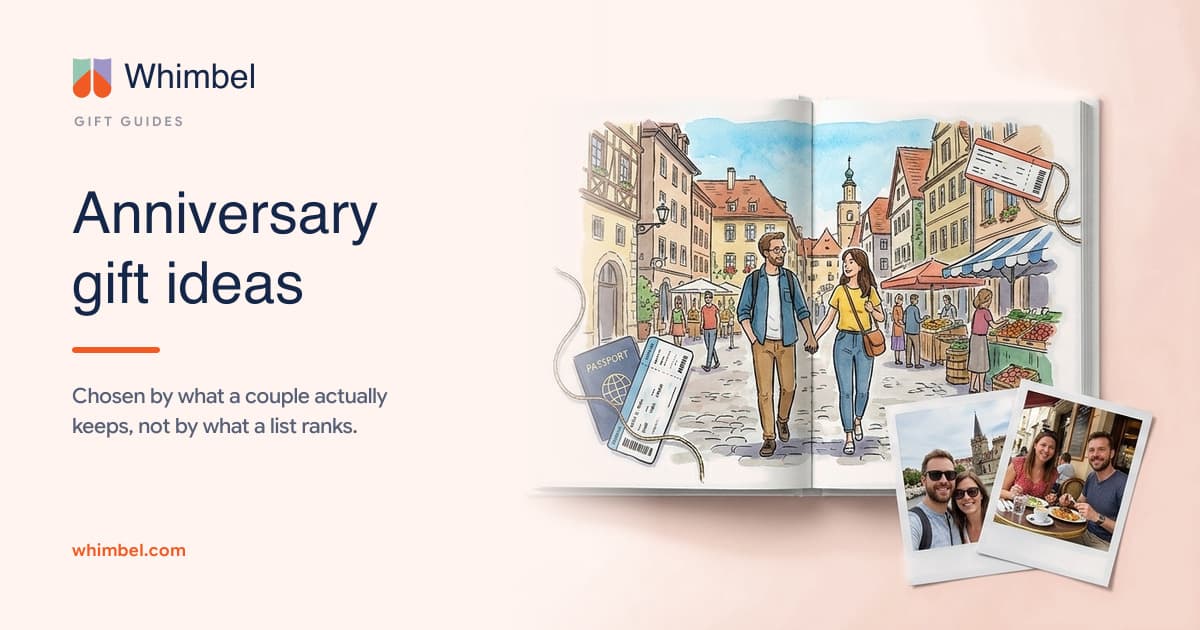
Anniversary gift ideas built around one finding that actually predicts what works: couples who do something new together report better relationships than couples who do something familiar. Every figure below links to its source, and where a source is paywalled the guide says so and gives the page number.
Key takeaways
- Doing something novel together beats doing something familiar together, and it has been tested rather than asserted: in three laboratory experiments of 28, 63 and 35 couples, couples showed greater increases in relationship quality after a seven-minute novel and arousing task than after a mundane one. The link to relationship boredom is a separate, correlational result from the same paper's newspaper questionnaire (112 people) and door-to-door survey (80) (Aron et al., Journal of Personality and Social Psychology, 2000).
- 57% of a national sample said an experiential purchase made them happier than a material one, against 34% who said the reverse (Van Boven & Gilovich, 2003). Carry the qualification with it: that is a plurality in every row of the paper's subgroup table, not a majority, and it falls under half among the oldest, rural and retired or unemployed respondents.
- 55% say they keep personalized gifts much longer than generic ones — on average a full year longer — and nearly 40% say they would keep one forever (OnePoll for Vistaprint, 2,000 Americans, posted 15 November 2019). A commissioned consumer survey, not a study, and the page states no field dates.
- Retailers expect 17% of holiday sales to be returned (NRF and Happy Returns) — the forecast of 358 merchants surveyed before the season, not a count of returns that happened.
- The traditional year-by-year list is a convention, not an authority, and its usual attribution could not be verified. See the note at the end.
Anniversary gift ideas are usually presented as a lookup problem: find the year, find the material, buy the material. That is a way of narrowing a decision, not a way of making a good one, and it explains why so many anniversary presents are technically correct and instantly forgotten.
There is a better starting point, and unusually for this subject it has been tested.
The finding worth organising an anniversary around
In 2000, Aron and colleagues published a set of studies in the Journal of Personality and Social Psychology examining what shared activities do to a relationship. They used a newspaper questionnaire (112 respondents), a door-to-door survey (80) and three laboratory experiments (28, 63 and 35 couples).
The questionnaire and survey found the predicted correlation between reported shared exciting activities and relationship satisfaction, mediated by relationship boredom. That half is correlational, and boredom appears nowhere in the experiments. Then the experiments tested the direction of the effect: in all three, couples showed greater increases in experienced relationship quality after participating together in a seven-minute novel and arousing task than after a more mundane one. A no-activity control confirmed the effect came from the novel task rather than from the time together, and the same effect appeared in outside ratings of videotaped discussions recorded before and after.
Seven minutes. Not a holiday, not a grand gesture — a short shared activity that was unfamiliar.
One limit belongs with the finding, because it cuts against the way this research is usually quoted. The oldest participant documented anywhere in that paper is 54, and the two later experiments recruited only couples who had been together fifteen years or less — the authors say longer-together couples tended to be older and were often a problem for a physically demanding task. So the result is well evidenced for younger and mid-length relationships and untested on couples much older than that.
That still reframes the whole question. The best anniversary gifts are not the ones that best represent the number of years. They are the ones that produce an afternoon the two of you have not had before.
Best anniversary gifts: things you do
The experiential-versus-material research points the same way. Across a national sample of 1,279 Americans, 57% said an experiential purchase made them happier than a material one, against 34% who said the reverse. The two figures do not add up to a hundred because the rest said they were unsure. It is worth knowing what the sample was: a telephone survey of people who identified themselves as the primary financial decision-maker in their household, aged 21 to 69, fielded by Harris Interactive in November and December 2000, with 1,263 responses analysed after exclusions.
Worth reading the finding carefully rather than as a slogan, though: the same paper reports that women, younger people and urban or suburban respondents favoured experiences more strongly than men, elderly and rural respondents did. That is a plurality in every row of its subgroup table, not a majority — 49% against 38% at ages 55 to 69, 49% against 40% in rural areas, 47% against 39% among retired or unemployed respondents. Two groups outside that table go further: the paper says respondents with the lowest incomes were equally likely to name a material purchase, and those with the least education were slightly more likely to. The survey's oldest band stops at 69, so it says nothing at all about couples past that. If you are buying for a couple older than the people in it, treat "just book something" as a weaker default than the internet implies, and read the next section too.
A class in something neither of you can do. This is the Aron finding in its most literal form: novel, shared, slightly demanding. Pottery, sailing, a language, knife skills. The point is not the skill — it is that neither of you is the expert.
A day in a place you have both never been. Not a familiar favourite. Familiar is the mundane condition in the experiment.
Tickets to something one of you would never choose. The novelty is doing it together, and the story afterwards is usually about the mismatch.
The trip, booked and dated. Undated intentions are not gifts. A date in a calendar is.
Something absurd and small. A seven-minute unfamiliar thing is a legitimate gift. An axe-throwing session, a dance lesson, a silly competition. The research does not say the activity has to be dignified.
Wedding anniversary gifts: things that last
The object case is not weaker than the experience case, it is different, and for anniversaries specifically it has one thing going for it: an object marks a date, and a date is what an anniversary is.
On personalization, the honest number is modest. A OnePoll survey of 2,000 Americans commissioned by Vistaprint and posted on 15 November 2019 found 55% say they keep personalized gifts much longer than generic, store-bought ones — an average of a full year longer — with nearly 40% saying they would keep one forever. That is a commissioned consumer survey rather than research, the page gives no field dates, and it measures what people say rather than what they demonstrably do. It is still the best available number, and it agrees with the obvious.
Something with the actual date on it, not the year number. "12 June 2011" beats "15 years" because it points at a day rather than a total.
The repair. The ring resized, the watch serviced, the photograph restored, the chair reupholstered. Almost nobody gives this and it is close to unbeatable — it returns something already loved to use.
A gift for their parents, from both of you. Overlooked, and it lands. An anniversary is a good excuse to do the thing neither of you has got round to — our guide to gifts for grandparents covers that side, and the recorded-interview idea in it is the one people wish they had done sooner. A book made for them out of the family's own story is on our grandparent gift book page, which is ours and therefore not a neutral suggestion.
A print of somewhere specific. The street, not the city. The venue, not a heart-shaped map of the country.
Replace the thing you have both been putting up with. Unromantic, correct, and used daily for years.
Anniversary gift ideas by year, and why the list is weaker than it looks
The traditional list — paper, cotton, leather, wood at five, silver at twenty-five, gold at fifty — is genuinely useful as a constraint. A constraint makes choosing easier, and "find something made of paper" is a better prompt than "find something nice".
But treat it as a convention rather than a rule, for two reasons.
The first is that it is folklore with a tidy origin story attached, and we could not verify the origin story. The list is very widely credited to librarians at the Chicago Public Library. We tried to confirm that on the library's own site and could not: the site did not serve us a page we could read. So this guide describes the list as a widespread convention and does not tell you who wrote it, because we do not know.
The second is that the material is a theme, not an instruction. The good version of a paper anniversary is a letter, a ticket, a print or a book — not an object made of paper for the sake of it. Use the year as a way in and then ignore it.
What to skip
Retailers expect 17% of holiday sales to be returned, against 15.8% across the year and 19.3% for online sales. All three are retailers' own estimates rather than counted returns. Anniversary gifts have a particular failure mode on top of that: they are bought to mark something, so a bad one is conspicuous.
Anything that only says the number. A "20 Years" ornament marks arithmetic. It contains nothing about the twenty years.
Generic engraved jewelry. Engraving a first name onto a mass-produced piece is personalization in the weakest sense. A date, a place, or a phrase only the two of you use is personalization in the real one.
A repeat of last year. The Aron result cuts directly against tradition-for-its-own-sake: the same restaurant on the same date is the mundane-activity condition. Keep the ritual if it matters, and add one unfamiliar thing to it.
Anything requiring them to organise it. An unbooked voucher transfers the work to the recipient. Book it.
A surprise trip for someone who hates surprises. Obvious, and it still happens every year.
Where a personalized book fits, and where it does not
We make illustrated hardcover books from a family's own memories, so read this section as interested rather than neutral.
The case for it here is specific and it sits precisely between the two halves of this guide: it is an object, so it marks the date and stays in the house — but what it contains is a shared experience, told. If the research says novel shared experiences are what strengthen a relationship, a book about one you already had is the closest an object gets to that.
It also has an advantage over most anniversary objects: it cannot be bought for anybody else. A necklace could go to any partner. A book about the flat you both hated could not.
The full detail on how it is made is on the personalized book for adults page, and what it costs is on our pricing page — that is where the product lives, and this article is deliberately not a sales page for it. The storybook for any age page covers the same thing for other relationships.
The case against, plainly: it takes time you may not have, it needs a photograph of each person in it, and it is the wrong gift if what your relationship actually needs this year is the seven unfamiliar minutes rather than another object on a shelf. If you read the first half of this guide and recognised yourselves, book the class instead. That advice is better than ours.
Frequently asked questions
What are the best anniversary gift ideas?
Something you do together that neither of you has done before. That is not a preference — across three laboratory experiments of 28, 63 and 35 couples, couples showed greater increases in relationship quality after a seven-minute novel and arousing shared task than after a mundane one. The link to relationship boredom comes from the same paper's questionnaire and door-to-door survey, which are correlational, rather than from the experiments. A class, an unfamiliar place, or tickets to something outside both your habits all qualify. Familiar favourites are the condition that did not work.
What is a good wedding anniversary gift that lasts?
Something carrying the actual date rather than the year count, or a repair of something already loved — a ring resized, a watch serviced, a photograph restored. On personalization generally, a OnePoll survey for Vistaprint found 55% say they keep personalized gifts about a year longer than generic ones, with nearly 40% saying they would keep one forever.
Should you follow the traditional anniversary gift list by year?
Use it as a constraint, not a rule. "Find something made of paper" is a more useful prompt than "find something nice", and constraints make choosing easier. But the material is a theme rather than an instruction — the good version of a paper anniversary is a letter or a ticket, not an object made of paper for its own sake. The list's usual attribution is also unverified; see the note below.
Are experiences really better anniversary gifts than objects?
On average yes, and with a caveat worth knowing. 57% of a national sample said an experiential purchase made them happier than a material one against 34% saying the reverse — but the same paper reports that elderly and rural respondents favoured experiences less strongly than younger and urban ones did. That is a plurality in every row of its subgroup table rather than a majority, and it drops under half among the oldest, rural and retired or unemployed respondents. The survey's oldest band stops at 69, so it says nothing about couples past that; for an older couple, weight the object ideas more heavily than a gift guide usually would.
How much should you spend on an anniversary gift?
There is no reliable published figure we could verify and we are not going to invent one. The strongest idea in this guide — a short, unfamiliar shared activity — is also among the cheapest, and the strongest object idea is a repair of something you already own.
What can you give for an anniversary when you both have everything?
A repair, a date, or a story. Repair something already loved rather than adding an object. Book something unfamiliar and put the date in both calendars. Or record the thing neither of you has written down: how you met, the year that was hard, the running joke nobody else understands.
How this guide was made
Every figure here comes from a page or paper we opened, most recently on 28 August 2026, and each links to its source. Both papers were read from the published articles themselves rather than from summaries of them. The Van Boven and Gilovich figures were read from the full text of the published article — the headline figures on p. 1196, the subgroup table on p. 1197 — and they link to that article's permanent publisher record, doi:10.1037/0022-3514.85.6.1193. That record is paywalled and shows the abstract only, so a reader who follows it lands on the citation rather than on the numbers.
Three things in an earlier version were corrected against the sources rather than repeated. Relationship boredom was credited to Aron's three experiments; it is a correlational result from the paper's newspaper questionnaire and door-to-door survey, and the experiments tested the causal direction instead. "A majority in every group" was wrong: the paper claims a greater proportion rather than a majority, and five rows of its subgroup table sit under 50%. And a sentence here used to send readers off to buy for "a couple in their seventies" on the strength of this research. No page we opened supports that, so it is dropped: the oldest participant documented in the Aron paper is 54, the Van Boven survey stops at 69, and the guide now says what the samples actually cover instead.
One more thing was deliberately left unattributed. The traditional anniversary list is almost universally credited to librarians at the Chicago Public Library, and that attribution appears on dozens of pages. We tried to confirm it at the library's own domain and the site did not serve us readable content. Rather than repeat an attribution we could not check, this guide calls the list a convention and does not say who compiled it. If the library publishes it, the credit is theirs and we simply could not see the page.
The recommendations are editorial judgment rather than research findings, and they are informed by the fact that we sell one of the things on the list.
Sources
- Aron, A., Norman, C. C., Aron, E. N., McKenna, C. & Heyman, R. E., "Couples' Shared Participation in Novel and Arousing Activities and Experienced Relationship Quality," Journal of Personality and Social Psychology, 78(2), 273-284 (2000) — DOI 10.1037//0022-3514.78.2.273. Five studies: a newspaper questionnaire (N = 112), a door-to-door survey in Santa Cruz (N = 80), and three laboratory experiments (28 couples, 63 married couples, 35 married couples); the paper states no field dates. Source in this article of the seven-minute novel-and-arousing task producing greater increases in relationship quality than a mundane one in all three experiments, with a no-activity control confirming the effect, and of the boredom mediation, which is a correlation found in the questionnaire and survey only. The oldest participant documented in any study is 54. Read from the paper. PDF, hosted by Baruch College, CUNY
- Van Boven, L. & Gilovich, T., "To Do or to Have? That Is the Question," Journal of Personality and Social Psychology, 85(6), 1193-1202 (2003) — Study 2 is a nationwide telephone survey of 1,279 Americans aged 21 to 69, all self-identified primary household financial decision-makers, fielded by Harris Interactive for Northwestern Mutual Financial Network in November and December 2000; 1% declined the key question and were excluded, giving an analysed N of 1,263. 57% (95% CI 54-60%) said their experiential purchase made them happier; 34% (95% CI 31-37%) said their material purchase did; the remainder were unsure. Source in this article of those figures and of the subgroup pattern: women, younger individuals and urban or suburban respondents favoured experiences more than men, elderly people and rural respondents did. Table 3 reports a greater proportion favouring experiences in every row, but that is a plurality and not a majority — ages 55-69 are 49% against 38%, rural 49% against 40%, retired or unemployed 47% against 39% — and the table carries no confidence intervals or significance tests. The headline figures are on p. 1196 and Table 3 on p. 1197, and both were read from the full text of the published article. The publisher's copy is paywalled, so the link below is the article's permanent publisher record rather than a readable full text. Van Boven & Gilovich, J Pers Soc Psychol 85(6), 1193-1202, doi:10.1037/0022-3514.85.6.1193
- Vistaprint, "Study: US personalized holiday gifts more popular" — survey of 2,000 Americans conducted by OnePoll; posted 15 November 2019, and the page states no field dates. A commissioned consumer survey, not peer-reviewed research. Source in this article of the 55% who keep personalized gifts much longer, the average of a year longer, and the nearly 40% who say they would keep one forever. vistaprint.com
- National Retail Federation and Happy Returns, "2025 Retail Returns Landscape" / "Consumers Expected to Return Nearly $850 Billion in Merchandise in 2025" — two surveys: 2,006 consumers who had returned at least one online purchase in the past twelve months, and 358 professionals working in ecommerce at US merchants with over $500 million in revenue. The report's methodology page dates the fieldwork August-September 2025; the press release calls it "this summer". Released 15 October 2025. Source in this article of 17% of holiday sales expected returned, 15.8% annual and 19.3% online — all three are retailers' own estimates, and the 17% is a forecast made by the merchant survey before the season, not a measurement. nrf.com
Every moment is a story waiting to be told.
Turn your family's real memories into a beautifully illustrated keepsake book.
Create your book