Gifts for Grandparents: Grandparent Gift Ideas, by Occasion
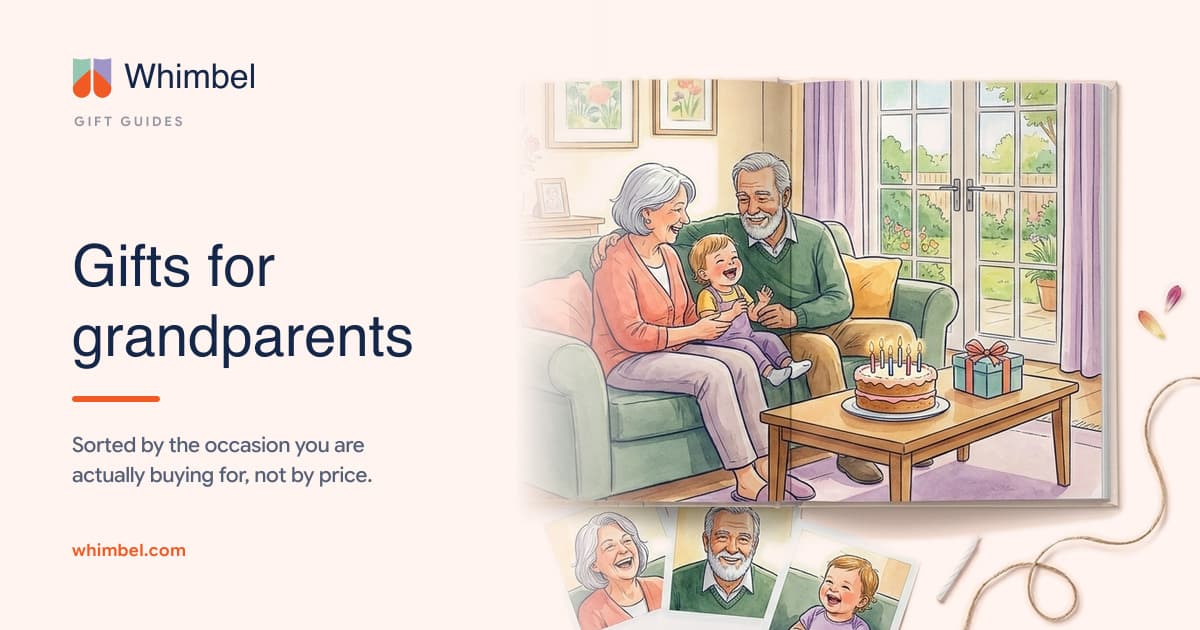
Gifts for grandparents, organized by the occasion you are actually buying for — because a birthday, a first grandchild and a retirement are three different problems. Every number links to the page it came from, and anything we could not verify was left out.
Key takeaways
- Nine in ten grandparents spend money on their grandchildren, averaging $2,654 a year across all of them, and 70% report no sacrifice or financial strain in doing it while 14% do (AARP, 2026). You are shopping for somebody who is already giving.
- Gifts for birthdays and holidays are what grandparents are most likely to spend on, but the money does not stop there: 41% help with basic necessities and 8% help pay for medical, dental or mental health care (AARP, 2026), and 23% spend on education and activities (AARP Research). A gift that reduces what they are carrying is worth more than one that adds to it.
- 76% say electronic technology is a primary way they stay connected, and half of grandparents over 80 text with their grandchildren (AARP Research). The gap to fill is not contact. It is something to hold.
- Merchants expect 17% of their 2025 holiday sales to be returned — a forecast made by 358 ecommerce professionals about sales, not a count of gifts (NRF and Happy Returns). If they are right, that is close to one item in six.
- The "give experiences, not things" rule is weaker here than the internet suggests: 57% of a national telephone sample of American household financial decision-makers, surveyed in 2000, said an experience made them happier against 34% for a possession, but among respondents aged 55 to 69 it was 49% against 38% — a plurality, not a majority (Van Boven & Gilovich, 2003).
There is a companion to this guide organized by how far away they live, because at Christmas distance is the variable that decides everything. The rest of the year it is not. A seventieth birthday, the week a first grandchild arrives and the month after a retirement are three genuinely different problems, and the same gift does not solve them.
So this guide sorts by occasion. Most grandparent gift ideas lists sort by price instead, which tells you what you can afford rather than what will land. Two facts sit underneath all of these.
The first is that you are shopping for somebody who is already giving. AARP's 2026 research found nine in ten grandparents spend money on their grandchildren, averaging $2,654 a year across all of them. Gifts for birthdays and holidays are what they are most likely to spend on, but they also cover clothing, food, school supplies, childcare, camps and family travel: 41% help with basic necessities, 23% with education and activities, 8% with medical, dental or mental health care. Those are counts of grandparents rather than shares of the money — AARP publishes no dollar split by category. Seventy percent say it involves no sacrifice or financial strain. Fourteen percent say it does.
The second is that contact is not the problem. Three-quarters of grandparents say electronic technology — texting, video calls, photo apps, group chats — is a primary way they stay connected, and half of those over eighty text with their grandchildren. Whatever a gift is for, it is not for closing a communication gap that has mostly already closed.
Birthday gifts for grandma and grandpa
The occasion where the "don't get me anything" problem is sharpest, in our experience, because a birthday has no wrapping-paper convention to hide behind.
Take "don't get me anything" literally. It usually means one of two specific things and they need different answers. I do not want more objects in this house is solved by something consumable, something that replaces an object they already own, or something not physical at all. I do not want you spending money on me is solved by something whose value is obviously time — and that is why the two ideas below land harder than anything expensive.
Interview them and keep the recording. Sit down with a phone and ask about their own life rather than the grandchildren's: where they grew up, how they met their partner, what their first job paid, what they were frightened of at twenty. Twenty minutes is plenty. This is the gift almost nobody thinks to give a grandparent, it costs nothing, and it is the only one on this list with a deadline attached.
Their handwriting, reproduced properly. One recipe card in their own hand — the stained one — scanned at high resolution and printed on decent paper, engraved on a board, or printed onto a tea towel. Two practical notes: photograph it flat in daylight with no flash, or it reproduces like a photocopy, and give the original back with it.
Repair the thing they still wear. The watch that stopped, the necklace with the broken clasp, the ring that no longer fits. Underrated, unglamorous, and immediately back in daily use. It also sidesteps the objects-in-the-house objection entirely, because the object is already there.
A dated day out, not an open invitation. Undated vouchers expire in drawers. Agree the date first, put it in your own calendar, and the voucher becomes a plan rather than an obligation.
Gifts for a first-time grandparent
The one occasion where they genuinely do want an object, and the only one where the recipient's role is brand new.
What they cannot buy for themselves is anything that says the word — grandma, grandpa, oma, nonna, whatever your family has settled on. Something carrying the name they have chosen, given by the parents, is the version of this that lands. Something carrying the baby's name is a gift to the baby that happens to live at their house.
Two practical notes. Ask which name they have chosen before engraving anything, because the intended name very often is not the one that survives first contact with a toddler. And the photograph they most want is the printed one of them holding the baby — not the baby alone.
Retirement, milestone birthdays, and the years when the calendar goes quiet
A seventieth, an eightieth, a retirement — occasions where the honest risk is a gift that reads as a full stop.
The useful move is to give something with a future in it rather than a summary of the past. A membership renewed with a second card for a grandchild, a course, a project with a finish line, a subscription to something they already read. The distinction matters more than it sounds: a retrospective gift at a retirement can land as an ending, and the person receiving it has usually been thinking about that already.
If you want to mark the achievement itself, make it specific. "Forty years of teaching" with the names of the schools beats "Happy Retirement" by a distance, because one of them could only be about them. A book written for and about the adult receiving it is where our own product sits in this category, and the same test applies to it: it has to be about them, not about the grandchildren.
Gifts for grandparents who help with childcare
AARP found that 69% of grandparents provide some level of care for their grandchildren, while 31% provide none (AARP, 2026). Across all grandparents — the ones providing no care included — the average is 510.9 hours of grandchild care a year, which the report frames as the equivalent of 12.5 weeks of full-time work. For the 2,350 respondents who do provide care, the only figure AARP publishes is a median of 260 hours a year. Separately, 79% say their grandparenting experience overall is extremely or very fulfilling (AARP, June 2026) — a question put to all 3,283 grandparents about grandparenting, not about the caregiving. So this is not a complaint. But the hours are real, and almost nothing in a normal gift guide acknowledges them.
Fix or replace what your child broke at their house. The step stool, the chair arm, the garden gate that stopped shutting. Unglamorous, used daily, and it requires you to have noticed — which is the actual content of the gift.
Buy the good version of the equipment they keep for your child. The travel cot that is not from 1994. The car seat that does not need a twenty-minute argument. Deeply unromantic, immediately used.
Give them time off without making it sound like criticism. A cleaner for the winter, a meal delivery for a month, a weekend where you take the children somewhere. Framed as thanks rather than as concern.
Gifts for grandma
Not a different category of object so much as a different conversation around the gift.
Something about her rather than about the grandchildren. The default gifts here are all pictures of somebody else — a frame of the children, a calendar of the children, a mug with the children on it. A gift that is about her is uncommon enough to be startling, which is why the interview and the handwriting ideas above sit at the top of this guide rather than the bottom.
Jewelry only if it is specific. A generic necklace is a returned necklace. A date that means something, the grandchildren's names in the order she would put them, or the repair of the piece she already wears — those work.
What to skip. Anything in the "World's Best Grandma" family, which is a gift about the sentiment of the giver rather than the taste of the recipient. Anything that needs a new shelf. Anything requiring her to create an account.
Gifts for grandpa
Three things come up repeatedly here, and all of them start from the same place: he will not have told anyone what he wants.
The worn-out thing he will not replace. The recurring pattern is somebody using a failing version of something they reach for constantly, because replacing a working object feels like waste. Doing it for him is not exciting and it is usually right.
Give him an archive job. The box of slides, the shoebox of prints, the camcorder tapes. Pay to have them digitized, then hand back the files and ask him to tell you who everyone is. That is two gifts, and the second one — being asked — is the one that matters.
A project with the grandchild that ends. A model, a birdhouse, a seed tray, a jigsaw big enough to leave out. A finish line turns it into a Saturday rather than a commitment.
The harder occasions
Rarely covered, and a real share of the situations people are actually shopping in.
The first birthday after a grandparent has died. Shop for the surviving partner, and the rule is acknowledge, do not surprise. A gift that reveals itself at a table as being about the person who died is a hard thing to be handed in company. Give it privately, earlier, and say what it is before they open it. The ones that work tend to keep the person's voice or handwriting rather than their face.
The year they are downsizing. If they have moved somewhere smaller in the last eighteen months or are about to, the correct number of new objects is close to zero. This is the clearest case in the guide for consumables, services and time. Adding to a house someone is trying to empty is a chore dressed as a present.
A grandparent living with dementia. The Alzheimer's Association publishes a gift guide for exactly this, and it is better than anything we could improvise. In its own description the suggestions are stage-specific, aimed at keeping the person engaged, safe and involved in everyday tasks. Under "In the early stages" it lists a memory calendar featuring family photos; for the middle-to-late stages it suggests music playlists of the person's favorite artists, comfortable loose-fitting clothing that is easy to put on, framed photographs or a collage created specifically for them, and soothing objects such as a handheld massage ball. A digital clock with large type sits under a third heading that is not stage-scoped at all — the one for everyday tasks — so do not treat it as an early-stage item. Read the guide before you buy.
What to skip, whatever the occasion
Retailers expect 17% of holiday sales to be returned, against 15.8% across the year and 19.3% for online sales (NRF and Happy Returns). That is a merchant forecast about sales rather than a measurement of gifts, but it works out at close to one item in six, and some categories are reliably in that sixth.
Cash or a gift card, in most cases. The person you are buying for already moves an average of $2,654 a year toward your family. Handing money back reads as a transaction, and it is very likely to be spent on your own children anyway.
Another photo frame. The frame is not the constraint; the printed photograph is. Print the photo and put it in a frame they already own.
Technology with an account attached. Any device whose setup involves creating a login, choosing a password and confirming an email is a gift with homework attached — unless you are there to do it. Note this is not an argument that grandparents avoid technology: three-quarters say it is a primary way they stay connected. It is an argument about who does the setup.
Auto-renewing subscriptions. A fixed-term subscription is a gift. An auto-renewing one is a bill you have introduced into someone else's house.
On experiences versus objects, honestly
Every gift guide repeats that experiences beat possessions, and the research does support it: across a nationwide cross-section of 1,279 Americans aged 21 to 69 — self-identified household financial decision-makers, reached by telephone for a Northwestern Mutual financial-planning survey — 57% said an experiential purchase made them happier than a material one, against 34% who said the reverse. The rest were unsure, and the percentages are computed on the 1,263 who answered the question (Van Boven & Gilovich, 2003).
The same paper says several things the popular version leaves out. Women, younger people and those in urban or suburban areas were more likely to favor experiences than men, elderly people and rural respondents were — and what the paper actually claims is a plurality in every group, and under half among the oldest, rural and retired respondents: 49% against 38% for ages 55 to 69, 49% against 40% for rural respondents, 47% against 39% for the retired and unemployed (Table 3, p. 1197). Outside that table the paper reports that respondents with the lowest levels of income were equally likely to name a material or an experiential purchase, and that people with the lowest levels of education were slightly more likely to say material possessions made them happier. On a guide about buying for grandparents specifically, that is not a technicality. It is a reason to treat "just book them a thing" as a weaker default here than it is elsewhere, and to take the object-based ideas in this guide seriously.
Where a personalized book fits, and where it does not
We make illustrated hardcover books from a family's own memories, so read this section as interested rather than neutral.
The case for it as a grandparent gift is specific. It is an object, which is what the 76%-connected-by-technology finding says is actually missing. It is about a real shared moment rather than a name dropped into a template. And it points in either direction: a book about the grandchild given to the grandparent, or a book about the grandparent — their childhood, their work, the thing they are known for in the family — which is the version people tend not to think of and the one that gets cried over.
Practically: a digital preview of the finished book is $7.99, the hardcover is $44.99 with the preview credited against it — the pricing page carries the current numbers. Shipping is free to the US, Canada, the UK and most of Europe; elsewhere a delivery fee applies, shown before you pay, and the shipping page covers all 180 countries we ship to. There is more on the grandparent gift book page, and the storybook for any age page covers books written for and about adults, which is what a tribute to a grandparent actually is.
The case against, plainly: it takes time you may not have, it needs a photograph of each person you want illustrated, and it is a poor choice if they are downsizing and genuinely want no new objects. If that is your situation, go back to the harder-occasions section — the answer there is a service or a visit, not a book.
Frequently asked questions
What do you get grandparents who say they don't want anything?
Separate the two things it usually means. If they do not want more objects, give something consumable, something that replaces an object they already have, or something not physical at all — a service, a repair, a booked visit. If they do not want you spending money, give something whose value is obviously your time: a recorded interview about their own life, their handwriting reproduced, a day out you organize. Both readings are answered by a gift that could not have been bought quickly.
What is a good birthday gift for grandma?
Something about her rather than about the grandchildren. Almost everything she receives is a picture of somebody else. Record an interview with her about her own early life, or have her handwriting from a recipe card or letter reproduced into something used daily. Both cost very little and neither can be given by anyone else in the family.
How much should you spend on a gift for grandparents?
There is no established figure specific to grandparents that we could verify, and we are not going to invent one. What is measurable is the other direction: they spend an average of $2,654 a year on their grandchildren, and 70% report no financial strain in doing it (AARP, 2026). Nothing in this guide requires a large budget, and the two strongest ideas in it — the recorded interview and the reproduced handwriting — cost close to nothing.
What can you give grandparents who live far away?
Something that leaves an object in the house or creates the next call rather than being one. In AARP's 2018 grandparenting study, more than half of grandparents had at least one grandchild living over 200 miles away (AARP, 2018) — that figure is eight years old, and the 2026 study measures distance differently, so treat it as the most recent number of its kind rather than a current one. We wrote a whole guide organized around it — see the Christmas one linked at the top, which sorts every idea by distance.
Should the gift come from the grandchildren or from the adults?
From the grandchildren, in almost every case, and it is the easiest upgrade available. The same object handed over by a four-year-old who helped choose it is a different gift from the same object handed over by their parent. Where the child cannot meaningfully take part, having them add something small — a drawing inside a cover, a recorded message, their name on the tag — is enough.
What is the best gift for grandparents who help with childcare?
Something that reduces the load or acknowledges it. AARP puts the average at 510.9 hours a year across all grandparents, including the 31% who provide none (AARP Research, 2026), which the report frames as the equivalent of 12.5 weeks of full-time work. Fixing what broke at their house, replacing the equipment they keep for your child, or arranging a weekend where you take the children all read as thanks rather than as concern.
How this guide was made
Every figure here was taken from a page we opened on 28 August 2026, and each links to the page that states it — not to a landing page, a bibliographic record or a press summary that mentions the study without carrying the number. The one exception is named where it applies: the 2003 Van Boven and Gilovich figures were read in the full text of the published article, which sits behind the publisher's paywall, so they link to the paper's permanent DOI record rather than to a copy we are not entitled to pass on.
Three claims were dropped rather than softened. The widely repeated statistic that 86% of grandparents buy gifts and spend an average of $805 a year on them appeared in a search summary, but it is on no AARP page we opened, so it is not in this guide. A line describing the Alzheimer's Association guide as advising that a gift be matched to the stage rather than to a recipient's earlier tastes was removed: the guide really is stage-specific, but the second half of that sentence is nowhere on the page, and we could not find it on any page we could open. And a claim that a birthday is the most-searched grandparent gift occasion after Christmas was cut, because we have no search-volume source we can show you.
Two AARP figures were re-based rather than repeated. The 510.9 hours of grandchild care a year is the average across all grandparents, including the 31% who provide none — not the average among the 69% who do; the only figure AARP publishes for caregivers alone is a median of 260 hours. And the 79% who call the experience extremely or very fulfilling were answering a question about grandparenting overall, asked of all 3,283 respondents, not about the caregiving. Separately, an earlier version of this guide told readers that AARP had found presents to be the smaller part of that spending. The cited page says the opposite — gifts for birthdays and holidays are what grandparents are most likely to spend on — so the sentence was reversed rather than quietly dropped.
Where a source says something more qualified than its popular version, the qualification is in the running text rather than a footnote. That is why the experiences-versus-possessions section states the subgroup percentages: the paper claims a plurality, not a majority, and the gaps are smallest among exactly the people this guide is about. Those figures now link to the paper's DOI, the permanent publisher record; the published full text is paywalled, and the percentages here — the headline pair on p. 1196 and Table 3 on p. 1197 — were read in it rather than in a summary. The university publication record this guide linked before carries none of them.
The recommendations are editorial judgment rather than research findings, and they are informed by the fact that we sell one of the things on the list. Where that is a conflict we have tried to say so in the same sentence.
Sources
- AARP, "Grandparents Provide $731 Billion in Unpaid Care of Grandchildren," Paul Wynn, 16 June 2026 — source of the $2,654 average annual spend, the nine-in-ten figure, the 70%/14% financial-strain split, the 41% basic-necessities and 8% health-care figures, the 69% who provide some level of care and the 31% who provide none, and the statement that gifts for birthdays and holidays are what grandparents are most likely to spend on. aarp.org
- AARP Research, "Powering Families: The Essential Role of Grandparents in Care, Connection and Support," June 2026 — 3,283 U.S. grandparents aged 35+, fielded 18 November to 22 December 2025, mixed-mode (2,962 online, 321 by telephone), margin of error ±1.71%. The study page is the source of the 23% education-and-activities figure, the 76% technology figure, the half-of-over-80s texting figure and the 12.5-weeks-of-full-time-work equivalence. The key findings deck is the source of the 510.9-hour average, which it labels as covering all respondents "including those with 0 hours." The annotated questionnaire is the source of the 260-hour median among the 2,350 respondents who provide care, and of the wording of the fulfilment question. The press release is the source of the 79% who find grandparenting extremely or very fulfilling; the study page rounds the same figure to 80%, and we used the 79% that the deck, the questionnaire and the release all report.
- AARP, "2018 AARP Grandparenting Study" — 2,654 grandparents aged 38+, fielded 20 August to 4 September 2018. Source of the more-than-half-have-a-grandchild-200-miles-away figure, which is 2018 data and is presented as such in the text. aarp.org
- National Retail Federation and Happy Returns, "Consumers Expected to Return Nearly $850 Billion in Merchandise in 2025" — two surveys, of 2,006 consumers who had returned at least one online purchase in the past twelve months and of 358 ecommerce professionals at U.S. merchants with more than $500 million in revenue; the press release says the two surveys were conducted "this summer", while the report's own methodology page (p. 26), which we opened from the research landing page, dates the fieldwork August–September 2025 — we do not link the report PDF itself, because its URL is a signed asset link that will not survive. Released 15 October 2025. Source of the 17% holiday return expectation, which is the retailer-survey estimate rather than a consumer figure, and of the 15.8% annual rate and the 19.3% online rate. nrf.com
- Alzheimer's Association, "Gift Guide for Caregivers and People Living with Dementia" — source of the stage-matched suggestions and of the placement of the large-type digital clock under the everyday-tasks heading. Not a survey; the association's own published guidance, with no publication date on the page, read on 28 August 2026. alz.org
- Van Boven, L. & Gilovich, T., "To Do or to Have? That Is the Question," Journal of Personality and Social Psychology, 85(6), 1193-1202 (2003), doi:10.1037/0022-3514.85.6.1193 — the nationwide survey is 1,279 Americans aged 21-69, self-identified household financial decision-makers, reached by random-digit-dial telephone for Harris Interactive on behalf of Northwestern Mutual Financial Network in November-December 2000; percentages are computed on the 1,263 who answered. 57% (95% CI 54-60%) said their experiential purchase made them happier, 34% (95% CI 31-37%) said their material purchase did (p. 1196). Table 3 on p. 1197 reports no confidence intervals, so the subgroup gaps are untested point estimates: ages 55-69 49%/38% (n=268), rural 49%/40% (n=246), retired or unemployed 47%/39% (n=218). Those figures and Table 3 were read in the full text of the published article; the publisher's copy is paywalled, so the link here is the permanent publisher record rather than free full text. Van Boven & Gilovich, J Pers Soc Psychol 85(6), 1193-1202, doi:10.1037/0022-3514.85.6.1193
Every moment is a story waiting to be told.
Turn your family's real memories into a beautifully illustrated keepsake book.
Create your book