Deployment Books and Objects for Kids: What Actually Helps
Books and objects that help a child through a parent's deployment — and the official free resources that should be your first stop, before anything you buy. Every figure below links to the page it came from.
Key takeaways
- Start with the free official resource, not a purchase. The Department of Defense's Military OneSource points families to Sesame Street for Military Families, "a free multimedia website that features engaging videos, fun apps, helpful tip sheets and articles", built to help children ages 2 to 8 through "relocations, deployments, transitions and more", in English and Spanish (Military OneSource).
- It covers deployments, relocations, family caregiving, and grief and healing — the harder cases as well as the ordinary ones.
- A book's job here is to be re-read, not to be read once. The AAP tells parents and caregivers to "recognize that one of the most important purposes of play with toys, especially in infancy, is not educational but rather to facilitate warm, supportive interactions and relationships" — that is advice about toys, and about babies rather than about deployment, but in our view it is still the right test to apply to an object bought for a child whose parent is away (AAP).
- The object matters most in the gaps — the weeks when calls are impossible. That is the specific problem worth solving.
Search results for deployment books are almost entirely lists of published picture books, and those lists are useful. This guide assumes you can find them and answers the question underneath: what actually helps, and in what order.
Before you buy anything
There is already a free resource built for exactly this, produced in cooperation with the Department of Defense, and it is better than most of what you could buy.
Military OneSource describes Sesame Street for Military Families as "a free multimedia website that features engaging videos, fun apps, helpful tip sheets and articles", designed to "help children ages 2 to 8 and their parents through the complexities of relocations, deployments, transitions and more." It is "offered in both English and Spanish", and it covers deployments, relocations, family caregiving, and grief and healing.
It costs nothing and it is age-targeted. On who stands behind it, the precise wording matters: the site is run by Sesame Workshop, and its own footer reads "Provided in cooperation with the U.S. Department of Defense, Military Community & Family Policy" (sesamestreetformilitaryfamilies.org). That is cooperation rather than funding — the partners page keeps "Provided in cooperation with:" as a separate label from "Major support provided by:", and the funders under that second label are mostly corporate — Walmart, American Greetings, Bristol-Myers Squibb — though two Defense Department components, the Defense Health Agency and Military OneSource, are credited with major support for individual initiatives (Homecomings and Changes, Grief) rather than for the site as a whole.
On how it was made, the site says its resources are "developed in close collaboration with military families", and the partners page lists a 24-person advisory roster identified by credentials alone, with no roles or affiliations given — three M.D.s, two Ph.D.s, two Ed.D.s, two licensed clinical social workers, a registered nurse and several retired senior officers among them. What it does not say is what any of those advisors did, or when, so neither will we. Start there. If what you are looking for is a gift, come back to this page afterwards — but do not let a purchase substitute for a resource that is free and better.
What a deployment object is actually for
The useful distinction is between the times when contact is possible and the times when it is not.
When calls are happening, a child does not need much scaffolding. When calls stop — a transit, an operational blackout, a time zone that puts every window in the middle of a school day — the child needs something that does not require the absent parent to be available.
That is the job. An object that works only when the parent is reachable solves the easy half of the problem.
What works
A recorded read-aloud, made before departure. The single highest-value thing on this list, and it has a deadline: it can only be made while the parent is there. Record several books, not one — one wears out fast and then the loss of it is a second loss. Video if you can, audio if not.
A book they can hold, read by whoever is present. The point of a physical book here is that it works in the blackout. The AAP's framing fits, though it is advice about toys for young children rather than about deployment: the object exists to produce warm interaction, not to teach. It matters less what the book is about than that it is re-read.
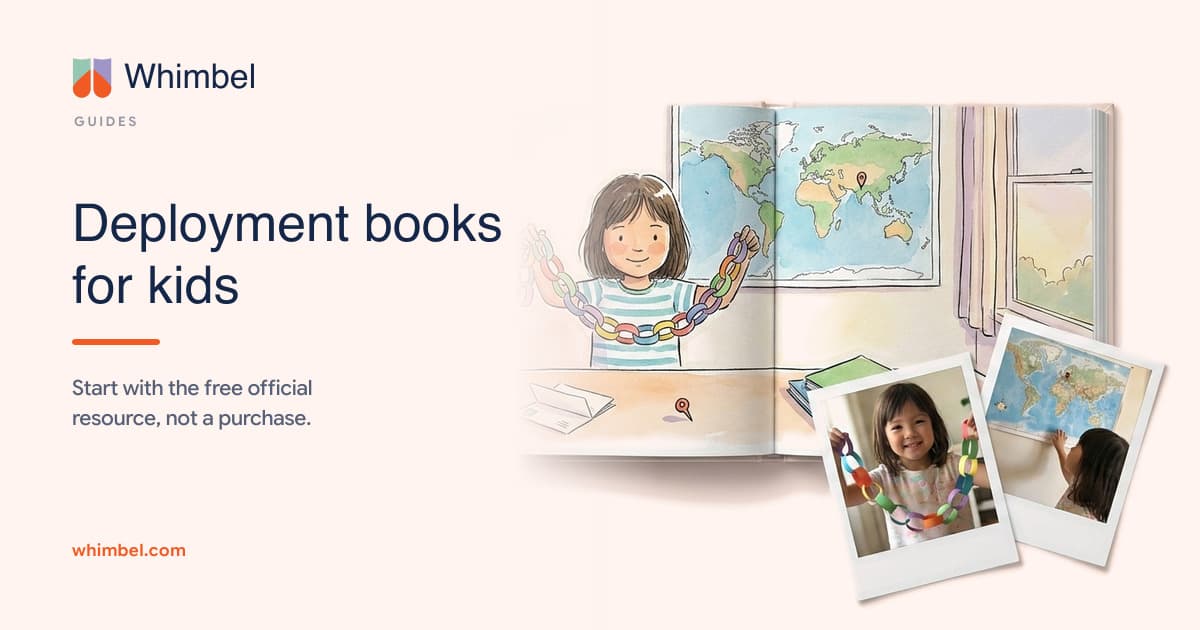
A countable, physical calendar. Small children cannot hold "six months". They can move a peg, take a link off a paper chain, or fill a jar. Concrete beats numeric well past the age you would expect.
Two of the same object. The same small toy, bracelet or keyring in both places. It gives a child something to point at on a call and something to hold when there is no call.
A letter to be opened later, dated. Written before departure, opened on a birthday or a bad week. The advantage over a call is that its timing is under the child's control rather than the schedule's.
A map with one pin. Older children in particular want to know where, and a vague answer is usually worse for them than a plain one.
What to be careful with
Do not promise a date. Return dates move. A child who has been told a number and then experiences it passing has learned something about how much to trust what they are told, which is a harder problem than the original absence.
Be careful with anything that only works with the parent present. A gift that depends on a scheduled call inherits the call's unreliability.
Do not make the object a performance of coping. If the child is expected to be visibly comforted by it, it becomes another thing to manage for the adults.
Avoid anything that frames the absence as an adventure the child is missing out on. The child is not on a deployment; they are at home, and the framing lands as their loss being smaller than it is.
For the parent who is leaving
Almost every list is written for the parent who stays. Two things are worth doing from the other side, and both have to happen beforehand.
Record more than feels necessary. Several books, a few "goodnight"s, an ordinary conversation. Ordinary is the part that gets missed; occasions are already covered.
Write things down for the child to have later. Not letters about missing them — descriptions. What you do on a normal day, what the food is like, what is funny. A Defense Department site gives the adults around a child nearly the same advice: Military OneSource tells them to "Talk about where their parent is right now, and what their life might look like. Do they sleep in a tent or on a ship? Where and what do they eat?" Treat that as advice rather than as evidence: it is what an official site recommends adults do, not a measured outcome.
Where a book we make fits, and where it does not
We make illustrated hardcover books from families' own memories, so read this as interested rather than neutral — and on this page the honest answer is usually no.
The free resource above is better than a purchase for the core need, and a published deployment picture book by an author who knows the subject is better than a bespoke one for helping a child understand what deployment is. We do not do either of those things.
The narrow case where a bespoke book helps is different: not explaining deployment, but holding what the family is like — a book about a real ordinary day with the parent who is away, made before they go, for the child to have while they are gone. That is a "who we are" object rather than an educational one.
The storybook for any age page covers how that works, the grandparent gift book page covers the version made by a grandparent at a distance, and our long-distance guide covers keeping a relationship going across a gap generally. If you have time before a departure it is worth considering, and our pricing page says what one costs before you start; if the departure is next week, record the read-alouds instead. That is better advice than ours and it is free.
Frequently asked questions
What helps a child cope with a parent's deployment?
Start with Sesame Street for Military Families, the free resource for children aged 2 to 8 that Military OneSource signposts and that is produced in cooperation with the Department of Defense, covering deployments, relocations and grief in English and Spanish. Then build things that work when calls are not possible: recorded read-alouds made before departure, a physical countdown a child can touch, and a book that gets re-read by whoever is present.
What are good deployment books for kids?
Published picture books written specifically about deployment are the right tool for explaining what is happening, and there are good lists of them. Separately, any book the child will re-read matters more than the subject — the object's real job is producing warm interaction with the adult who is there, which the AAP names as one of the most important purposes of play with toys, especially in infancy.
Should you tell a child exactly when the parent is coming home?
Be careful. Return dates move, and a child who has been given a number and then watches it pass learns something about how far to trust what they are told. A physical countdown that can be adjusted is easier to manage than a promised date.
What should the deploying parent do before leaving?
Record more than feels necessary — several books rather than one, a few goodnights, an ordinary conversation. Ordinary is what gets missed; occasions are already covered. And write down descriptions of daily life: Military OneSource tells the adults around a child to talk about where the parent is right now, whether they sleep in a tent or on a ship, and where and what they eat.
Do keepsakes actually help during a deployment?
We have no data saying so and are not going to claim it. What can be said plainly: the specific gap is the period when contact is impossible, and an object works in that gap where a scheduled call does not. Whether that helps a particular child is not something a gift guide can tell you.
Where should a military family go for real support?
Military OneSource is the Department of Defense's own entry point and signposts the Sesame Street resource among others. Nothing on this page is a substitute for it.
How this guide was made
The resource description is quoted directly from Military OneSource, an official Department of Defense site. The AAP quotation is from its consumer explainer for the Pediatrics clinical report on toys, quoted as the full sentence it is — it ends "warm, supportive interactions and relationships", and it is a recommendation the AAP makes to parents about toys and infants, not a finding about older children. Every page cited here was opened on 28 August 2026, including the Sesame Street for Military Families home page, its partners page and its FAQ.
Three things in the first version of this guide were wrong and have been corrected in place; two more were dropped outright, below. It said the Department of Defense funds the Sesame resource; the site says it is provided in cooperation with DoD Military Community & Family Policy, and its partners page lists that under a different label from its funders. It said the resource was built with people who work with military children; the site says its resources are developed in close collaboration with military families and lists 24 advisors without saying what they did, so the sentence now says only what the site says. And it upgraded the AAP's "one of the most important purposes of play with toys" into a claim that this is the single most important one; the AAP declines to rank it that way, and the quotation now runs as the page has it.
Everything else here is editorial judgment and is marked as such. We deliberately did not include statistics about deployment and child outcomes. Figures exist and are widely repeated, but the ones we found traced back to summaries rather than to a source we could open, and this is not a subject to be approximately right about. One specific claim was dropped for that reason: an earlier version of this guide asserted, in the body and again in the FAQ, that a child who has a picture of where a parent is copes better than a child imagining it. We looked for a source and could not find one that says it — not in Sesame's own facilitator guide, not in the published work on ambiguous loss in military families, not on the Defense Department's own pages. What survives is the Military OneSource advice quoted above, which recommends the conversation without claiming an outcome. A count was dropped too: the article used to say this was one of exactly two guides on this site where our product is the wrong answer, and we cannot pin the number to two.
The section above says our product is usually the wrong answer here, and it says so before it says anything else.
Sources
- Military OneSource (U.S. Department of Defense), "Sesame Street for Military Families" — source of the description, the ages 2 to 8 range, the topics covered, and the English/Spanish availability. militaryonesource.mil
- Military OneSource (U.S. Department of Defense), "Supporting the Children You Love During a Parent's Deployment" — guidance for extended family and friends, not a study; source of the advice to talk about where the deployed parent is and what daily life looks like. militaryonesource.mil
- Sesame Street for Military Families — the resource itself, and the source of the footer line "Provided in cooperation with the U.S. Department of Defense, Military Community & Family Policy". sesamestreetformilitaryfamilies.org
- Sesame Street for Military Families, "Our Partners" — source of the separate "Provided in cooperation with:" and "Major support provided by:" labels, and of the 24-name advisory roster. No affiliations or roles are given for the advisors on the page. sesamestreetformilitaryfamilies.org/partners
- Sesame Street for Military Families, "Frequently Asked Questions" — source of "developed in close collaboration with military families" and of the description of the site as free and bilingual. sesamestreetformilitaryfamilies.org/faq
- American Academy of Pediatrics, "Ignore the Flashing Screens: The Best Toys go Back to the Basics" — consumer explainer published 3 December 2018 for the clinical report Selecting Appropriate Toys for Young Children in the Digital Era, Pediatrics. Source of the warm-interaction recommendation, quoted in full. healthychildren.org
Every moment is a story waiting to be told.
Turn your family's real memories into a beautifully illustrated keepsake book.
Create your book