Reading to Your Baby From Birth: What the AAP Actually Says
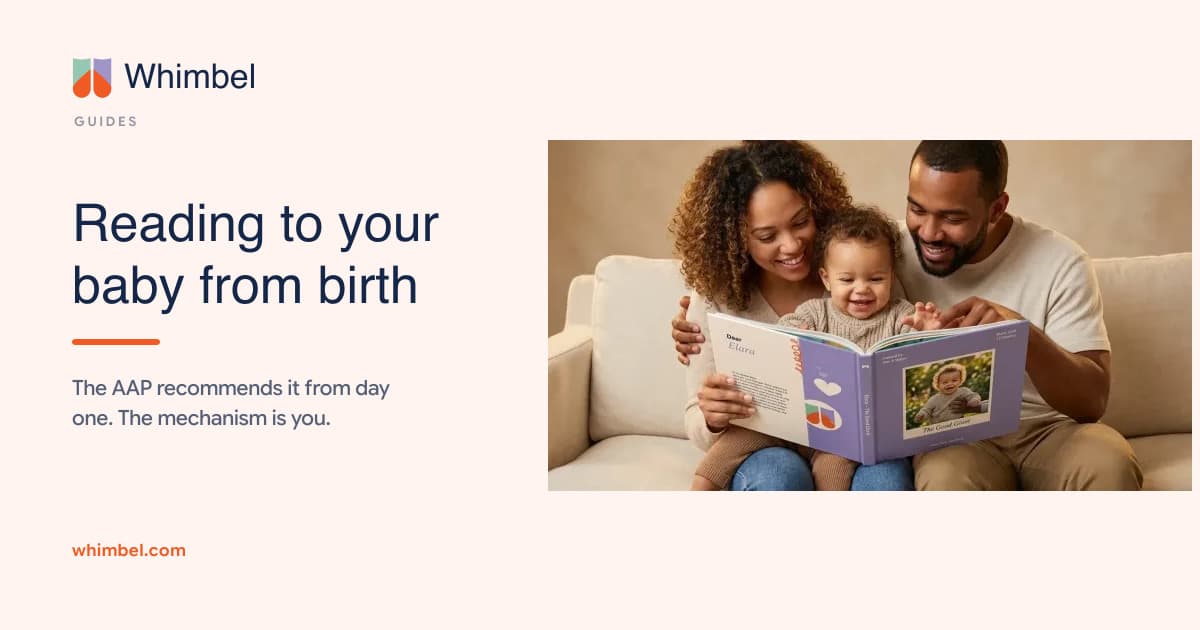
Reading to a baby from birth, using the AAP's 2024 policy statement rather than the statistics that circulate about it. The recommendation is clearer and more specific than the numbers people quote, and it is quoted here directly.
Key takeaways
- From birth, and the AAP says so in those words. The 2024 policy statement "recommends that pediatricians encourage shared reading, beginning at birth and continuing at least through kindergarten", and asks separately for "Supporting parents to initiate reading together, starting in the newborn period, including, when possible, in the NICU." The single sentence everyone quotes, which folds the two together, is the wording of the AAP's news release.
- The stated benefits are not only literacy. The AAP names "healthy social-emotional, cognitive, language and literacy development" and effects on "sustained attention, executive function, self-esteem and social behavior".
- How you read matters as much as that you read. The AAP calls for "mutually joyful and developmentally appropriate reading activities" and "meaningful, language-rich engagement with books, pictures and the written word."
- Screens are not a substitute, and the policy says why in its own words. "Touchscreens and other electronic devices are passive or solitary experiences for children, whereas reading with children is interactive, tactile, language-rich, and nurturing" (policy statement PDF).
- A newborn cannot follow a story, and that is not the point. The relationship is the mechanism the policy describes.
The case for reading to babies is usually made with a striking number — a word gap, a percentage, a multiplier. Those numbers are mostly misquoted, including by us in an earlier version of this article. The policy itself is stronger and does not need them.
What the AAP actually recommends
The 2024 policy statement Literacy Promotion: An Essential Component of Primary Care Pediatric Practice is the first update since 2014. The AAP's news release summarises its instruction to clinicians as "encourage shared reading beginning at birth and continuing at least through kindergarten, including, when possible, in the neonatal intensive care unit (NICU)", and that is the sentence almost everyone quotes. The policy statement itself says it in its own words: the AAP "recommends that pediatricians encourage shared reading, beginning at birth and continuing at least through kindergarten, as a strategy for supporting parents and caregivers", and the NICU is a separate item on its list for clinicians — "Supporting parents to initiate reading together, starting in the newborn period, including, when possible, in the NICU."
Note what is being claimed. Not that reading makes babies smarter. The AAP's news release about the policy calls shared reading "an opportunity to foster loving, nurturing relationships during a critical time of brain development"; the policy statement's own abstract puts it as reading together "strengthens their relationships with parents and caregivers at a critical time in child development, stimulating brain circuitry and early attachment" (policy statement PDF). Shared reading builds a foundation for "healthy social-emotional, cognitive, language and literacy development", and the AAP names effects on "sustained attention, executive function, self-esteem and social behavior".
The third-grade line is worth quoting properly, because the popular version stops halfway. Perri Klass, lead author of both the policy statement and its technical report, is quoted in the AAP's news release saying "Research tells us that reading proficiency by third grade is a significant predictor of high school graduation and career success." The policy statement makes the same point and then finishes the sentence: even before the pandemic, "approximately two-thirds of children in the United States and 80% of those living below the poverty threshold failed to develop reading proficiency by the end of third grade." That is a measure of how far short the system falls, not a promise that bedtime stories close the gap on their own.
The relationship is the mechanism, and it is why a newborn who cannot follow a story is still the right audience.
How to read to a baby, per the policy
The AAP is specific that style matters, calling for "mutually joyful and developmentally appropriate reading activities" and "meaningful, language-rich engagement with books, pictures and the written word."
In practice, three things follow.
Talk about the pictures rather than only reading the words. "Language-rich engagement with books, pictures and the written word" is broader than reciting text, and with a baby the pictures are the whole conversation.
Joyful is a requirement, not a bonus. The word is in the recommendation. A grim daily ten minutes is not what is being described, and if a book is not working, the book is the thing to change.
Let the baby direct it. Chewing the book, turning three pages at once, ending after ninety seconds — all of that is engagement rather than failure.
What to read, by rough age
Editorial judgment rather than policy, and marked as such.
Newborn to about 3 months. Anything. Genuinely anything — your own book aloud counts, because at this age the value is your voice and attention. High-contrast images hold attention slightly better.
3 to 6 months. Board books that survive a mouth. Faces. Rhythm and repetition over plot.
6 to 12 months. Books with a physical component — flaps, textures, holes. This is where "engagement with pictures" becomes obvious, because they will start pointing.
12 to 24 months. The same book, repeatedly, for weeks. Repetition is the mechanism at this age, not a phase to be waited out.
Any age. Books about their own family and their own week, which is the only category where the pictures are of people they know. That category includes what we sell — our new baby book is one of ours — and the case against it is set out further down, before you get anywhere near a checkout.
On screens, which the policy addresses directly
The AAP's position on device reading is unusually plain. The policy statement puts it flatly: "Touchscreens and other electronic devices are passive or solitary experiences for children, whereas reading with children is interactive, tactile, language-rich, and nurturing." The softer version that circulates — that devices "may be popular" but "are typically passive or solitary experiences for children and do not offer the same benefits of interactivity and relationship-building" — is Dipesh Navsaria, co-author of the accompanying technical report, speaking in the AAP's news release rather than the policy text. Both point the same way; only one of them is the policy.
The distinction is not paper versus glass in the abstract — it is whether an adult is in the loop. An app reading aloud on its own does not provide the back-and-forth interaction of shared reading with an adult.
What a clinic-based reading programme changes, measurably
The AAP policy is a recommendation. Reach Out and Read — the programme that puts books into paediatric visits, which is what the policy is largely arguing for — publishes outcome figures for families exposed to it.
On its own evidence page: parents are 2.5 times more likely to read with their infants, toddlers and preschoolers, and twice as likely to read with their children three or more times per week. It also states that children's language development is improved by 3–6 months.
Two caveats worth carrying. These are figures published by the programme about itself, not an independent meta-analysis, and the page gives no sample size for any of them — although the organisation also states that "the body of independent, peer-reviewed, and published research supporting the efficacy of the Reach Out and Read model is more extensive than for any other psychosocial intervention in general pediatrics", citing more than twenty studies in journals including Pediatrics and Academic Pediatrics. And they measure the effect of a programme, not of reading in isolation.
What they are good for is the direction: the intervention that changes behaviour is a clinician handing a family a book and talking about it, not a leaflet. If your paediatrician does this, that is the mechanism working.
What to be careful with
Do not chase a target. Numbers about how many books or words per day circulate widely and are frequently attached to the wrong study. The policy does not set a quota.
Do not treat a short session as a failed one. Ninety seconds counts.
Do not save the good books. A destroyed board book has done its job.
Do not read to prove anything. The policy describes joy and relationship, and reading performed as an obligation is a different activity that happens to involve a book.
Where a book we make fits, and where it does not
We make illustrated hardcover books from families' own memories, so read this as interested rather than neutral.
The honest position: what matters here is that you read, not what you read, and a library card achieves the recommendation completely and for free. Nothing in the AAP's policy says the book has to be about your family, and we are not going to imply otherwise.
The narrow case where a book about the child's own family does something a library book cannot is repetition. Toddlers ask for the same book for weeks, and a book whose pictures contain people they know tends to be one of the ones asked for. That is a claim about our own observation of what gets re-read, not a research finding, and it is worth exactly what that is worth.
The first birthday book and baby milestones book pages cover what we make. The screen-free activities guide covers the wider question of what to do instead of a device.
If you take one thing from this article, take the sentence from the policy and not the sentence about us: shared reading, beginning at birth, joyful.
Frequently asked questions
When should you start reading to a baby?
At birth. The AAP's 2024 policy statement "recommends that pediatricians encourage shared reading, beginning at birth and continuing at least through kindergarten", and separately asks clinicians to support parents "to initiate reading together, starting in the newborn period, including, when possible, in the NICU." The tidier one-sentence version that runs the two together, NICU and all, is the wording of the AAP's news release rather than the policy's. A newborn cannot follow a story, and the policy's stated mechanism is the relationship rather than the comprehension.
What are the benefits of reading to a baby?
The AAP names a foundation for "healthy social-emotional, cognitive, language and literacy development" and effects on "sustained attention, executive function, self-esteem and social behavior". Its news release about the policy describes shared reading as "an opportunity to foster loving, nurturing relationships during a critical time of brain development", and the policy statement itself says reading together strengthens relationships with parents and caregivers, "stimulating brain circuitry and early attachment." The third-grade line people quote is Dr. Perri Klass speaking in that release; the policy statement carries the same point together with the half that usually gets dropped, that about two-thirds of US children were not reading proficiently by the end of third grade even before the pandemic.
Does it matter how you read to a baby?
The AAP says so explicitly, calling for "mutually joyful and developmentally appropriate reading activities" and "meaningful, language-rich engagement with books, pictures and the written word." Talking about the pictures counts. So does stopping after ninety seconds because the baby is done.
Is reading on a tablet as good as a physical book?
The 2024 policy statement says "Touchscreens and other electronic devices are passive or solitary experiences for children, whereas reading with children is interactive, tactile, language-rich, and nurturing." The distinguishing factor is whether an adult is in the loop rather than the material the pages are made of.
How many books a day should you read to a baby?
The policy sets no quota, and we are not going to invent one. Numbers of this kind circulate widely and are commonly attached to the wrong study — see the note below about what this article previously got wrong.
Does it have to be a children's book?
For a very young baby, no. The active ingredient the policy describes is your voice, your attention and the interaction. Your own book read aloud is a legitimate version of that in the newborn weeks.
How this guide was made
The AAP material here comes from two documents, both opened on 28 August 2026: the AAP's news release summarising the 2024 policy statement, and the AAP-typeset PDF of the policy statement itself, mirrored at Reading Rockets, which opens and was read in full. Three of the lines usually attributed to "the policy" are in fact the news release's wording rather than the policy's. Two are spoken quotes from named authors inside that release — Dr. Dipesh Navsaria on touchscreens, Dr. Perri Klass on third-grade reading. The third is the release's one-sentence summary of the beginning-at-birth recommendation, the version with the NICU folded into it; the policy states that recommendation in different words and puts the NICU on a line of its own, and the word "neonatal" does not appear in the policy at all. In each case this article names where the wording comes from and quotes the policy's own alongside. One earlier quotation here had its verb altered inside the quotation marks, from "foster" to "fosters"; it now reads as the release wrote it. The publisher's page for the policy at publications.aap.org still returns 403 behind a Cloudflare challenge, which is why every link to the policy points at the mirrored PDF instead. The Reach Out and Read figures come from that organisation's own evidence page, which publishes no sample sizes for them, and the text says plainly that they are self-published programme outcomes rather than independent findings.
Four numbers from the earlier version of this article were removed and not replaced. It claimed babies read to from birth hear 1.4 million more words by kindergarten. The Ohio State paper behind that figure attaches the 1.4 million to roughly five books a day, and puts a child read one book a day at 296,660 words by their fifth birthday against 4,662 for a child never read to — and all of those are modelled estimates, built from the word counts of 60 commonly read children's books applied to national reading-frequency benchmarks, not a measurement of any child's actual word exposure. It said brain imaging shows language-region activation in babies as young as three months; the study in question looked at nineteen children aged three to five. It said only 48% of infants are read to daily, citing CDC data we could not locate — we still cannot, and that one is simply gone, with nothing put in its place. And it said a baby is born with roughly 100 billion neurons; the paper that actually counted reports the adult male brain at 86.1 ± 8.1 billion on average, and calls the 100 billion a widespread quote for a number that "remains unknown."
Three of those four now carry a link to the page we opened, because the correction is only worth anything if a reader can check it. None of them has been promoted back into the argument: the article makes its case from the policy rather than from a word count, and it is a better case.
Sources
- American Academy of Pediatrics, "Beyond Literacy: Shared Reading Starting at Birth Offers Lifelong Benefits" (published 29 September 2024) — the AAP's news release summarising its 2024 policy statement Literacy Promotion: An Essential Component of Primary Care Pediatric Practice, the first update since 2014. Source of the widely quoted one-sentence summary of the beginning-at-birth recommendation — the version with the NICU inside it — as well as the named benefits, the reading-style guidance, and the two spoken quotes attributed above to Dr. Navsaria and Dr. Klass. healthychildren.org
- Klass P, Miller-Fitzwater A, High PC, et al; AAP Council on Early Childhood, "Literacy Promotion: An Essential Component of Primary Care Pediatric Practice: Policy Statement," Pediatrics, 154(6), e2024069090 (December 2024) — the policy statement itself. Source of the policy's own beginning-at-birth wording and of the separate NICU recommendation, the touchscreen sentence, the abstract's line on brain circuitry and early attachment, and the third-grade sentence in full. The publisher's own page returns a 403 Cloudflare challenge; the AAP-typeset PDF (734 KB) opens on the Reading Rockets mirror, which is the copy we read and the copy linked. readingrockets.org PDF
- Reach Out and Read, "The Evidence" — the programme's own outcome page. Source of the 2.5x and 2x reading-frequency figures and the 3–6 month language development figure, and of the claim about the breadth of its peer-reviewed evidence base. No sample sizes or field dates are published for these outcome lines, which is stated in the text above. reachoutandread.org
- Logan JAR, Justice LM, Yumuş M, Chaparro-Moreno LJ, "When Children Are Not Read to at Home: The Million Word Gap," Journal of Developmental & Behavioral Pediatrics 40, 383–386 (2019) — modelled word counts from 60 commonly read children's books applied to national reading-frequency benchmarks; no child's word exposure was measured. Cited above only to correct our own earlier misquotation of it (296,660 words for one book a day, 1,483,300 for multiple books a day, 4,662 for never, cumulative birth to fifth birthday, Table 2). crane.osu.edu PDF
- Hutton JS et al., "Home Reading Environment and Brain Activation in Preschool Children Listening to Stories," Pediatrics 136(3), 466–478 (2015) — nineteen children aged three to five, drawn from an existing longitudinal study of normal brain development; correlational, controlling for household income. Cited above only to correct our own earlier misquotation of it. PubMed Central
- Azevedo FAC et al., "Equal numbers of neuronal and nonneuronal cells make the human brain an isometrically scaled-up primate brain," Journal of Comparative Neurology 513(5), 532–541 (2009) — direct cell counts on four adult male brains (aged 50, 51, 54 and 71), giving 86.1 ± 8.1 billion neurons on average; the sample size is in the paper itself, the linked PubMed abstract gives only the average. Cited above only to correct the 100 billion figure our earlier version used. The publisher's page is paywalled; what is linked is the PubMed record at the National Library of Medicine, which carries the abstract. PubMed record, PMID 19226510
Every moment is a story waiting to be told.
Turn your family's real memories into a beautifully illustrated keepsake book.
Create your book