Screen-Free Activities for Toddlers, With the Actual WHO Limits
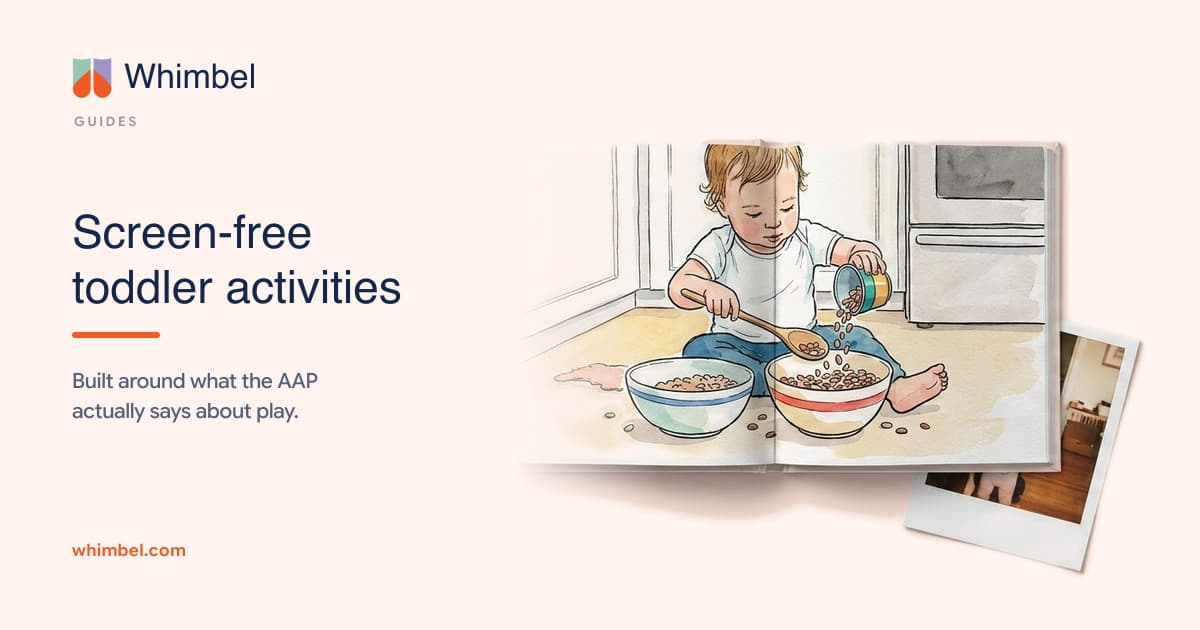
Screen-free activities for toddlers, with the WHO guidance quoted from the guideline itself rather than from the summary of it that circulates. Every screen-time line below is quoted from the 2019 WHO guideline, ISBN 978-92-4-155053-6, and every AAP line from the page that carries those exact words.
Key takeaways
- The WHO publishes three age bands, and it splits the middle one. Infants under 1: "Screen time is not recommended." Inside the 1–2 band the two years are treated differently — for 1-year-olds, "sedentary screen time (such as watching TV or videos, playing computer games) is not recommended"; for those aged 2, "sedentary screen time should be no more than 1 hour; less is better." Ages 3–4 get that same one-hour ceiling (WHO guideline, 2019, Recommendations).
- So a one-year-old and a two-year-old do not have the same limit. And there is no WHO "two to five" band: the guideline covers children under 5 and stops at 3–4 years. What it gives those ages is a ceiling with a direction attached — "no more than 1 hour; less is better" — not an hour's allowance.
- The WHO grades all of this "Strong recommendations, very low quality evidence", printed directly under the three bullets. Strong recommendation, weak evidence base. That pairing is the WHO's own and it belongs beside the numbers.
- On what to do instead, the AAP is blunt: "The best toys are those that match your child's developmental skills and abilities and encourage the development of new skills" (AAP, Toy Buying Tips), and, on a separate page, "Electronic toys by themselves do not provide children with the interaction and parental engagement that is critical to healthy development, according to the report" (AAP, The Best Toys Go Back to the Basics).
- The AAP also reframes the point of the activity, and it writes it as advice to parents rather than as a finding. It asks caregivers to "recognize that one of the most important purposes of play with toys, especially in infancy, is not educational but rather to facilitate warm, supportive interactions and relationships." (AAP, The Best Toys Go Back to the Basics)
This article exists because the version of it we published before got the WHO guidance wrong. So the numbers come first, quoted from the guideline itself, and the activities come after.
What the WHO actually says, by single year
The guidance is a 2019 WHO guideline, Guidelines on physical activity, sedentary behaviour and sleep for children under 5 years of age (ISBN 978-92-4-155053-6). It is published in three age bands, not four, and it draws the one-year-old and two-year-old distinction inside the middle band rather than as bands of their own. The sedentary-time recommendations read, in the guideline's own words:
- Infants (less than 1 year): "Screen time is not recommended. When sedentary, engaging in reading and storytelling with a caregiver is encouraged."
- Children 1–2 years of age — one band, split in two: "For 1-year-olds, sedentary screen time (such as watching TV or videos, playing computer games) is not recommended. For those aged 2 years, sedentary screen time should be no more than 1 hour; less is better."
- Children 3–4 years of age: "Sedentary screen time should be no more than 1 hour; less is better."
Three things follow that most summaries lose. The one-year-old and the two-year-old are treated differently, inside a single band. The recommendation at two is not "one hour" but "no more than 1 hour; less is better" — a ceiling with a direction attached, which is a different instruction from an allowance. And the guideline stops at 3–4 years, so a "two to five" band is not something the WHO published; it makes no recommendation for a five-year-old at all.
The wording differs between the bands too, and the difference is deliberate. Infants get an unqualified "Screen time is not recommended." One-year-olds get "sedentary screen time", which the guideline's own glossary defines as "Time spent passively watching screen-based entertainment (TV, computer, mobile devices)" and which, in the same entry, "Does not include active screen-based games where physical activity or movement is required." The infant line is the broader of the two.
All three bullets carry one grading line underneath them: "Strong recommendations, very low quality evidence." The WHO is stating these strongly while saying plainly what the evidence behind them is worth, and both halves of that belong in any article that quotes the hour.
The guidance is also not only about screens. Its framing is that children need to sit less and play more, with screen time being one form of sedentary behaviour among several — which is how the WHO's announcement of 24 April 2019 put it as well.
What the AAP says to do instead
The AAP's clinical report on toys, Selecting Appropriate Toys for Young Children in the Digital Era, is the most useful counterpart, because it says what a good alternative looks like rather than only what to avoid. We did not open that report; the lines below are quoted from the AAP's own consumer pages about it, which is where these exact words appear.
From the AAP's explainer of the report: "The best toys are those that match your child's developmental skills and abilities and encourage the development of new skills." And from the AAP's news piece on it, on electronics: "Electronic toys by themselves do not provide children with the interaction and parental engagement that is critical to healthy development, according to the report." The hedge inside that sentence — by themselves — is the AAP's own, and it is doing real work: the claim is about an electronic toy left to perform on its own, not about electronics as a category.
And the reframe that makes the whole thing easier, which the AAP writes as an instruction to parents rather than as a research finding: "Recognize that one of the most important purposes of play with toys, especially in infancy, is not educational but rather to facilitate warm, supportive interactions and relationships."
Read as a practical rule: the activity does not have to be educational and it does not have to be impressive. It has to involve you. That removes most of the pressure from the list below.
Activities that need nothing bought
A container and things to put in it. The most reliable toddler activity in existence. A box, a bag, a pot, and objects that fit. Fill, empty, repeat.
Water, anywhere. A washing-up bowl on a towel, cups, a sponge. Supervised, and the mess is the activity rather than a side effect.
A "posting" game. A slot cut in a shoebox lid and anything that goes through it. This is precisely the AAP's developmental-match idea — it lands exactly where a toddler's hands are.
Laundry. Sorting, carrying, matching. Toddlers want to do what adults are doing far more than they want a purpose-built toy.
Cooking, badly. Stirring, pouring, tearing herbs. Slow and worth it.
A walk with one job. Find three red things. Collect five leaves. The job is what turns a walk into an activity for a two-year-old.
Reading the same book again. Repetition is the point, not a limitation of it — and reading with a caregiver is the one sedentary thing the WHO guideline names as encouraged, under every age band.
Activities for when you have nothing left
Written for the hour when the honest question is what will work while you sit down.
A bowl of dried pasta and two containers. Supervised. Astonishingly durable.
Stickers. Any surface you have agreed to sacrifice.
Tape on the floor. A line to walk, a shape to fill, a road for cars.
The "what's in the bag" game. Five household objects, one at a time, out of a bag. Works far longer than it should.
An audiobook or a story you tell badly. Not a screen, and it buys twenty minutes.
What to be careful with
Do not treat the guidance as a scoreboard. The WHO's own framing is that less is better, not that a day containing screen time is a failure. Guilt is not one of the recommendations.
Do not buy the electronic version of a simple thing. This is the AAP's specific point, with its specific hedge: a toy that performs by itself is doing the part you should be doing.
Do not confuse "educational" with "good". The AAP's actual words are "one of the most important purposes of play with toys, especially in infancy, is not educational but rather to facilitate warm, supportive interactions and relationships" — one of the most important, not the only one, and stated most strongly for the youngest children rather than ranked above everything else.
Do not assume the limit is the same at one and at two. It is not, and that error is the reason this article was rewritten.
Where a book fits, and where it does not
We make illustrated hardcover books from families' own memories, so read this as interested rather than neutral.
The case is straightforward and small: a book is a screen-free activity that requires an adult, which is exactly what the AAP describes as the point, and it is the one sedentary thing the WHO guideline actively encourages — "When sedentary, engaging in reading and storytelling with a caregiver is encouraged" is printed under all three age bands. Our own view, and it is only that, is that a book about the child's own family gets asked for again more often than a generic one; we have not found a study we could open that measures it, so treat that as our opinion and not as evidence. If you want the version we make of it, that is the personalized storybook.
But any book does this. A library card does it for free, and the list above is mostly a shoebox and some pasta. If you came here for activities, the activities are the answer and we are a footnote to them.
For this age specifically, the first birthday book and baby milestones book pages cover what we make, and the first birthday gift guide covers buying for a one-year-old generally.
Frequently asked questions
How much screen time is recommended for a toddler?
It depends on the year. The WHO's 2019 guideline says screen time is not recommended for infants under 1, and that for 1-year-olds sedentary screen time is not recommended either; for those aged 2, and for children aged 3–4, it should be "no more than 1 hour; less is better". Two details get lost in the popular summary of it: that is a ceiling with a direction attached rather than an hour's allowance, and the guideline stops at 3–4 years, so it makes no recommendation at all for a five-year-old.
What are good screen-free activities for a 2-year-old?
Filling and emptying containers, water play with cups and a sponge, posting objects through a slot cut in a box lid, helping with laundry, and walks with one specific job attached. None require buying anything, and all match what a two-year-old's hands and attention are actually doing.
Are educational toys better than simple ones?
Not by default. The AAP's position is that the best toys are those matching a child's developmental skills and abilities and encouraging new ones, and that electronic toys by themselves do not provide the interaction and parental engagement that is critical to healthy development. It also asks parents and caregivers to recognize that one of the most important purposes of play with toys, especially in infancy, is not educational but rather to facilitate warm, supportive interactions and relationships.
What can you do when you are too tired to play?
Dried pasta and two containers, supervised. Stickers on a surface you have agreed to sacrifice. Tape on the floor as a line or a road. Five household objects out of a bag, one at a time. An audiobook. All of these work while you sit down, and none of them is a failure.
Is any screen time actually harmful for a toddler?
That is a question for your child's doctor rather than a gift-and-activities site, and we are not going to answer it from a summary. What we can state precisely is what the WHO recommends by age, quoted above — and that the WHO itself grades those recommendations as strong ones resting on very low quality evidence. Its framing is that less is better, not that a single hour is a harm.
Does it count if the activity is boring?
Yes. In our experience the same book or the same posting game on the fifteenth day is doing more than a novel activity would, and we are telling you that as our own observation rather than as a finding, because we did not find a study we could open that measures it. The AAP's framing helps here too: the value it names is the interaction, not the novelty.
How this guide was made
The screen-time lines were taken from the WHO guideline itself — Guidelines on physical activity, sedentary behaviour and sleep for children under 5 years of age, WHO 2019, ISBN 978-92-4-155053-6, IRIS handle 10665/311664 — whose PDF was downloaded, extracted and read on 28 August 2026, alongside the WHO's announcement of 24 April 2019. The earlier version of this article quoted only the announcement while telling you the figures came from the primary source. The wording is word for word the same in both documents, so no number changed; the claim was still imprecise, and the guideline is now what is quoted and linked.
Three corrections to the WHO section. First, the age structure: the guideline has three bands — under 1, 1–2 and 3–4 — and makes the one-year-old and two-year-old distinction inside the middle band. The earlier version printed four bands as though the WHO had published four, which put our own taxonomy into the WHO's mouth. Second, we removed the claim that the popular "none under two, an hour after" summary shifts the WHO's threshold by a year. It does not, and we could not support it. What that summary does get wrong is checkable and is what the article now says: the WHO published no "two to five" band, and "no more than 1 hour; less is better" is a ceiling rather than an allowance. Third, the WHO's own grading of these recommendations, "Strong recommendations, very low quality evidence", is now printed next to them, and the glossary definition that separates the infant line from the one-year-old line is quoted rather than flattened.
The AAP quotations were re-attributed. They come from the AAP's consumer pages on healthychildren.org, not from the Pediatrics clinical report, which we did not open; the earlier version called one of them the clinical report's own central line. The developmental-match sentence is on the toy-buying-tips page. The electronic-toys sentence and the warm-interactions recommendation are on a different page, and the electronic-toys quote had been linked to the wrong one of the two. That quote now carries its two hedges, by themselves and according to the report. The warm-interactions quote had been cut two words early: it ends "warm, supportive interactions and relationships", and it is restored. The earlier version also promoted it from one of the most important purposes of play with toys to the single most important one. The AAP declines to rank it that way, so the upgrade is gone and the bullet is quoted as the AAP wrote it — as a recommendation to parents, not as a finding.
Two claims lost their evidence and were demoted to opinion. "A book about the child's own family is re-read more than a generic one, and repetition is the mechanism at this age" had no citation behind it; it now appears once, in the section where our commercial interest is declared, marked as our opinion, with no research claimed for it. "Repetition is how toddlers learn" was stated in the FAQ as a developmental fact with nothing behind it either, and is now written as our own observation. Neither was replaced with a substitute figure, and neither was softened into "research suggests".
Still dropped, from the version before this one: a "zero under two, one hour for ages two to five" rule that merges the WHO's bands and labels them with an age range the guideline never prints, and a claim that the average US toddler gets over three hours of screen time a day — a figure the statistics audit of our own blog found applies to a different age group entirely. No average-toddler-screen-time figure has been substituted, because we could not verify one for that age band from a source we opened.
The activities are editorial judgment, not research findings.
Sources
- World Health Organization, Guidelines on physical activity, sedentary behaviour and sleep for children under 5 years of age (2019, ISBN 978-92-4-155053-6, IRIS handle 10665/311664) — a guideline developed from evidence reviews and a guideline development group, not a survey, so no sample size or field dates apply. Source of every screen-time line quoted here, of the three age bands, of the glossary definition of sedentary screen time, and of the grading "Strong recommendations, very low quality evidence". The IRIS landing page renders only in a browser, so the words quoted here were read from the PDF rather than from that page. iris.who.int landing page · iris.who.int (PDF, 36 pp)
- World Health Organization, "To grow up healthy, children need to sit less and play more" (24 April 2019) — the announcement of that guideline, reproducing the same sentences word for word. Source of the "sit less and play more" framing and of the announcement date, which is not the same as the guideline's publication date. who.int
- American Academy of Pediatrics, "Toy Buying Tips for Babies & Young Children: AAP Report Explained" — the consumer explainer for the clinical report Selecting Appropriate Toys for Young Children in the Digital Era, Pediatrics; the report itself was not opened for this article. Source of the developmental-match line, and of that line only — the other two AAP quotations are not on this page. healthychildren.org
- American Academy of Pediatrics, "Ignore the Flashing Screens: The Best Toys go Back to the Basics" (published 3 December 2018) — source of the electronic-toys sentence and of the warm-interactions recommendation, both of which appear here and not on the toy-buying-tips page. healthychildren.org
Every moment is a story waiting to be told.
Turn your family's real memories into a beautifully illustrated keepsake book.
Create your book