Long-Distance Grandparenting: What Actually Closes the Gap
Long-distance grandparenting, starting from the finding that changes what the problem actually is: contact is not the shortage. Every statistic here is sourced to the AARP document that states it, and says which group it was measured on.
Key takeaways
- More than half of grandparents have at least one grandchild living over 200 miles away, and about a third live more than 50 miles from their nearest. Distance is the single biggest barrier to seeing grandchildren (AARP, 2,654 grandparents aged 38+, fielded 20 Aug–4 Sep 2018).
- 76% say electronic technology is a primary way they stay connected, and half of grandparents over 80 text with their grandchildren (AARP, 3,283 grandparents aged 35+, fielded 18 Nov–22 Dec 2025). The gap is not contact.
- Distance is not the only barrier. With four in ten grandparents in the workforce, competing schedules are the second largest obstacle (AARP, 2,654 grandparents aged 38+, 2018).
- 69% of grandparents provide some level of care, and grandparents average 510.9 hours of it a year — an average taken across all grandparents, including the 31% who provide none (AARP Research, Powering Families key findings, June 2026, p.13). Long-distance grandparents are mostly excluded from that, which is its own kind of loss.
Almost every guide to long-distance grandparenting starts from the assumption that the problem is not enough contact, and then recommends more video calls.
The data does not support that. Three-quarters of grandparents already name electronic technology as a primary way they stay connected, and half of those over eighty text. Contact has largely been solved. What has not been solved is that a video call is a window rather than a room: it ends, and nothing is left behind.
So this guide is about what to build around the calls rather than how to have more of them.
The shortage is shared context, not contact
A grandparent who lives nearby accumulates ordinary detail without trying — which shoes the child refuses to wear, what the argument at breakfast was about, that they have started saying "actually" before every sentence. A long-distance grandparent gets summaries.
That is the actual deficit, and it is why calls between grandparents and small children so often stall. Neither party has anything to point at.
The fix is to give the call an object or an activity, not a topic. In our experience "How was school?" fails with most children under about ten, and "Show me the thing you built" does not. That is our opinion, not a research finding.
What works, in rough order of how reliably
The ordering below is our judgement. We know of no trial on any of it, and we have not attached a number to a habit to make it look like there is one.
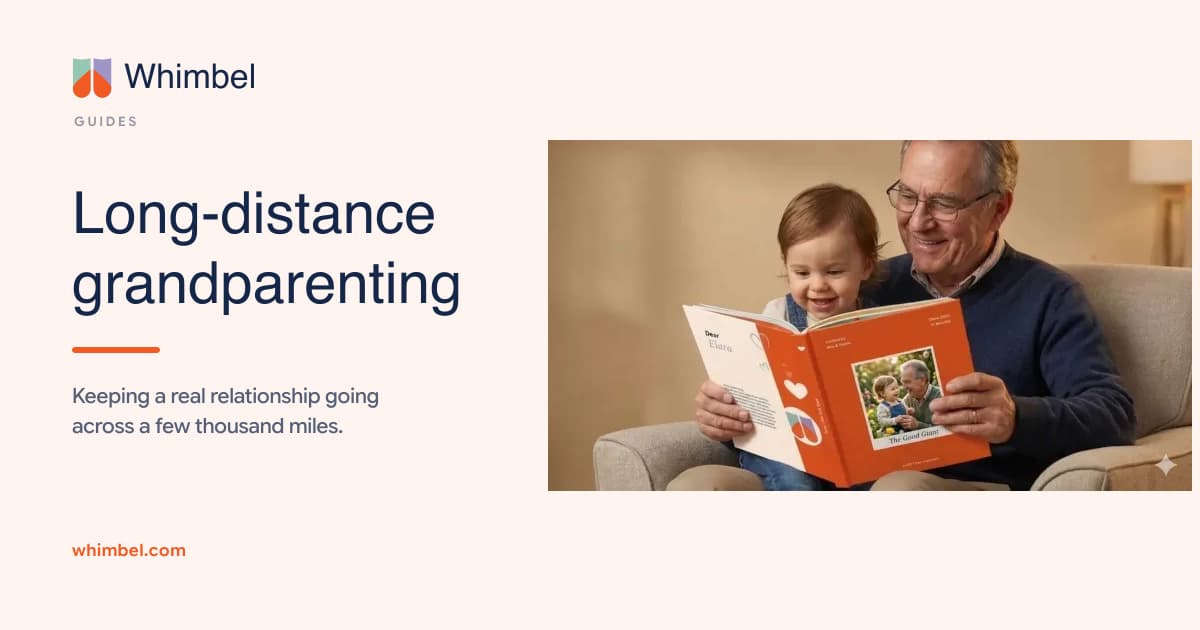
Two copies of the same book, one at each house. Read the same pages at the same time, both turning real paper. We would start it around age two, and it keeps working for years, because you can change the title without changing the ritual. It is the practice we would recommend first, and it costs the price of two books.
Recorded read-alouds, in both directions. Record the grandparent reading three books — not one, three, because one wears out — and give the child the recordings for bedtime. Then send the reverse. The practical detail that decides whether this happens: you do the recording, on your phone, during a visit. Asking a grandparent to produce and send video files is how this quietly never happens.
A parallel activity, not a conversation. The same jigsaw at both ends, the same recipe cooked simultaneously, the same seeds planted in two pots. Children who cannot sustain a chat can sustain an hour of doing something alongside someone.
A standing appointment rather than a spontaneous call. Same day, same time, short. Spontaneity favours the person with the freer schedule, which — given four in ten grandparents are working — is often neither party.
Something that arrives at their house with the child's name on it. A monthly subscription addressed to the grandparent, meant to be done with the grandchild on the next visit. It converts one gift into eleven reminders. This is also where our own product sits, so read the rest of this bullet as interested: a book made for a grandparent is the one-off version of the same idea, and the case against it is further down the page.
A photograph, printed and posted. Not a shared album. A physical print in an envelope, monthly. It is the thing that survives on a fridge, and our own rule is that something posted gets opened in a way a notification does not — an opinion about attention, not a finding about older people.
The video call, done better
Since three-quarters are already doing it, the useful advice is not "call more" but "call differently".
Shorter and more often beats long and rare. Our own rule is ten minutes twice a week rather than an hour on a Sunday, for any child under about ten. We have no data comparing the two, and are not going to invent any.
Give the child a job. Showing something, reading something, demonstrating something. Being interviewed is work; performing is not.
Let the call be boring. Leaving the tablet propped up while the child plays nearby is closer to how grandparents who live locally actually spend time. Not every call needs content.
Do not make the child perform gratitude. The fastest way to make a call something a child avoids is to use it to check they said thank you.
What this costs the grandparent, which nobody mentions
AARP found that about seven in ten grandparents — 69%, on its key findings deck — provide some level of care for a grandchild, and that grandparents average 510.9 hours of that care a year. The base matters and AARP states it on the same slide: that average is taken across all grandparents, including the 31% who provide none, so it is not the figure for a grandparent who actually does the caring. For that group AARP publishes no mean at all, only a median — 260 hours a year, among the 2,350 respondents who provide care.
Separately, four in five grandparents (79%) say the experience is extremely or very fulfilling. That question asked about grandparenting overall, of everyone in the survey — not about the caregiving, and not of carers only. AARP asked no fulfilment question about care specifically, so nobody can say from this study that the hours are the fulfilling part.
Long-distance grandparents are largely excluded from the caregiving half of it. The framing that they are missing the child's milestones is only half the story; they are also missing the practical version of the role — the watching, the driving, the homework — that the hours figure counts, and that is the version their nearby peers are counted doing.
That is worth knowing because it changes what to offer. An invitation to be useful — to teach something, to be asked advice, to be given a job during a visit — lands differently from an invitation to watch.
What does not work
A shared photo album nobody opens. Uploading is not sending. If it requires them to go and look, it will mostly not be looked at.
Technology that needs a new account. Any device or app whose setup involves creating a login and confirming an email is homework, unless you are physically present to do it. This is not a claim that grandparents avoid technology — three-quarters name it as a primary channel — it is a claim about who does the setup.
Guilt as a scheduling tool. Calls that happen because someone would otherwise be upset become calls children learn to dread.
Waiting for the child to be old enough to be interesting. Our view is that the habit is easier to build at two than to start at seven.
Where a book fits, and where it does not
We make illustrated hardcover books from families' own memories, so read this as interested rather than neutral.
The case here is the most specific on this site: the long-distance grandparent is short of an object, not of contact, and that is precisely what a book is. It also works in the direction people forget — a book about the grandparent, told from the grandchild's point of view, gives a child at a distance something to know them by rather than something to show them. That version is a book made for an adult rather than a children's one, and in our experience it is the harder of the two to find.
The grandparent gift book page covers how one is made, and our pricing page covers what it costs and what is included. The gifts for grandparents guide covers the occasion-by-occasion version of this question, and the Christmas one is organised by distance specifically.
The case against, plainly: it is a one-off, and the problem in this article is continuous. If you do one thing from this page, make it the two-copies-of-the-same-book habit — that is free of us, costs almost nothing, and repeats. A book is a good addition to that and a poor substitute for it.
Frequently asked questions
How can grandparents bond with a grandchild who lives far away?
Give the contact an object or an activity rather than a topic. Two copies of the same book, one at each house, read simultaneously over a call. The same jigsaw or recipe at both ends. Recorded read-alouds in both directions. Children who cannot sustain a conversation can sustain doing something alongside someone.
How often should long-distance grandparents call?
Our own rule is shorter and more often: ten minutes twice a week rather than an hour on a Sunday, for children under about ten. We have no data comparing the two, so treat it as a recommendation. Make it a standing appointment rather than spontaneous, because with four in ten grandparents in the workforce, spontaneity tends to suit neither side.
Is technology enough to keep a long-distance grandparent close?
It is already happening and it is not the gap. 76% of grandparents name electronic technology as a primary way they stay connected, and half of those over 80 text with their grandchildren. What a screen does not leave behind is an object, which is why printed photographs, posted letters and shared physical books do disproportionate work here.
How common is long-distance grandparenting?
It is the majority case. More than half of grandparents have at least one grandchild living over 200 miles away, and about a third live more than 50 miles from their nearest grandchild. AARP names distance as the single biggest barrier to seeing grandchildren, with competing schedules second.
What do long-distance grandparents actually miss?
Ordinary detail rather than milestones — which is what makes calls stall, because neither side has anything to point at. They also miss a role: 69% of grandparents provide some level of care, and across all grandparents the average is 510.9 hours a year, a figure that includes the 31% who provide none. Among those who do provide care AARP reports a median of 260 hours. An invitation to be useful lands differently from an invitation to watch.
What should you not do?
Do not rely on a shared album they have to go and open, do not give technology that needs a new account unless you are there to set it up, and do not use guilt to schedule calls. And do not wait until the child is old enough to be good company — in our view the habit is much easier to build at two than to start at seven.
How this guide was made
Every statistic comes from AARP, opened on 28 August 2026, with sample sizes and field dates given in Sources. Three of the 2026 figures are not quoted on the study's landing page in the form we use, so this guide links past it: the 69% care figure and the 510.9-hour average are on page 13 of AARP's key findings deck, and the 79% fulfilment figure is on page 4 of that deck and in the press release (the landing page rounds it to 80%). Where a figure is a median rather than a mean, or is calculated on all grandparents rather than on carers, the sentence says so.
Two corrections were made to an earlier version of this page, and both cut against how the numbers are usually quoted. The 510.9-hour average was previously attached to the 69% who provide care; AARP's own slide label says it is the average across all grandparents "including those with 0 hours", so the only defensible carer-base figure is the 260-hour median from the annotated questionnaire. And "four in five find it extremely or very fulfilling" was previously attached to caregiving; question 202 asks about the grandparenting experience overall, of all 3,283 respondents. The deck, the questionnaire and the press release all report 79%, so that is the figure used here.
The practices in this guide are our recommendations, not research findings, and six claims that previously read as findings have been rewritten to say so, in the body and wherever the FAQ repeats them: that ten minutes twice a week beats an hour on a Sunday, that "How was school?" fails under about ten, that the two-copies-of-a-book habit works from about age two, that it is the most reliable practice we know, that older grandparents treat post differently from a notification, and that the habit is easier to build at two than at seven. Every one of those was stated as a result and had no source behind it. They are now stated as opinion, in the sentence, which is what they always were. We have no data on which long-distance practices work best.
One claim was left out entirely. A widely repeated figure says grandparent–grandchild video calling rose by a specific percentage since 2020. The statistics audit of our own earlier blog found that figure attributed to Apple usage data that nobody could produce, so it is not here and no replacement was invented. The "12.5 weeks of full-time work" equivalence AARP puts on its landing page was also dropped: it is a restatement of the same all-grandparents average, and quoting both invites the base error a second time.
Sources
- AARP, "2018 AARP Grandparents Study" — 2,654 grandparents aged 38+, fielded 20 August–4 September 2018, online. Source of the distance figures (more than half have a grandchild over 200 miles away; about a third live more than 50 miles from the nearest), distance as the biggest barrier, and the four-in-ten-in-the-workforce schedule finding. aarp.org
- AARP Research, "Powering Families: The Essential Role of Grandparents in Care, Connection and Support" — study page — 3,283 US grandparents aged 35+, fielded 18 November–22 December 2025. Source of the 76% technology figure and the half-of-over-80s texting figure, both of which are stated on this page. aarp.org
- AARP Research, "Powering Families" — key findings deck (PDF) — same study; 3,283 grandparents aged 35+, data collected 18 November–22 December 2025 (p.22). Source of the 69% who provide care and the 510.9-hour average with its stated base of all respondents including those with zero hours (p.13), and of the 79% fulfilment figure (p.4). aarp.org (PDF)
- AARP Research, "Powering Families" — annotated questionnaire (PDF) — same study; its cover page (p.1) is where the sample of 3,283, the mixed mode (2,962 online, 321 by telephone) and the margin of error of ±1.71% are stated. Source of the 260-hour median for grandparents who provide care (Q702, n=2,350, p.28) and of the wording and base of the fulfilment question (Q202, asked of all 3,283 respondents, p.9). aarp.org (PDF)
- AARP press release, “New AARP Research Reveals $900 Billion ‘Grandparent Economy’ Powering American Families”, 15 June 2026 — reports the same study. Source of the wording used here for the 79% fulfilment figure. aarp.org
Every moment is a story waiting to be told.
Turn your family's real memories into a beautifully illustrated keepsake book.
Create your book